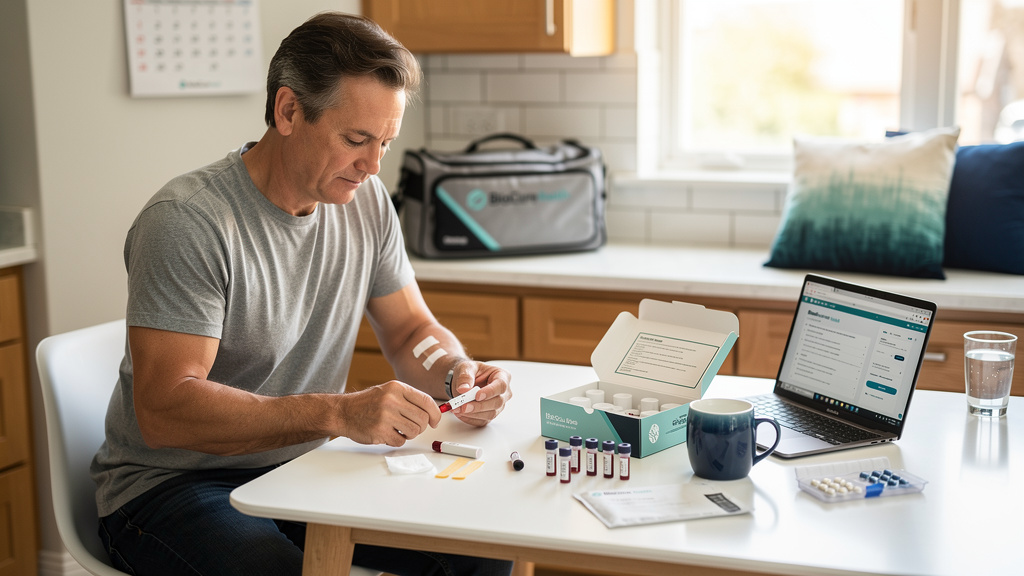
At-home hormone lab tests: how the blood draw works and what's measured
With a telehealth clinic, you get hormone blood work done in one of three ways: a finger-prick kit you mail back, a licensed phlebotomist who draws blood from a vein at your home, or a draw at a local lab. The sample goes to a lab, and a clinician reviews the results with you by video before anything is prescribed. At BioCure Health, the kit is delivered to your home, a phlebotomist comes to you for the draw, results arrive within 7 to 14 days, and a specialist walks you through them in a 1:1 consult.
That is the practical answer behind a bigger question: can you get hormone therapy without visiting a physical clinic? For most adults, yes. The blood draw is the piece that makes it work, so it is worth understanding how it is done well.
Three ways to do hormone labs remotely, and how they compare
The three methods are not interchangeable. The right one depends on what is being measured and how the result will be used.
| Method | How it works | Where it works well | Limits |
|---|---|---|---|
| Finger-prick kit | You prick a fingertip at home, collect drops of blood on a card or in a small tube, and mail it to a lab | Convenient, no appointment, useful for screening or tracking | Small sample volume limits how many markers can be run; too little blood or a collection error can mean starting over; not every marker is validated for this sample type |
| In-home phlebotomist | A licensed phlebotomist comes to your home, draws blood from a vein, and takes it to the lab | The same venous sample a lab would take, without the trip; easy to book an early, fasting slot | Depends on phlebotomist availability in your area |
| Local lab draw | You take a lab order to a patient service center | Widely available | Travel, waiting rooms, and lab hours that may not fit an early fasting draw |
The Endocrine Society's testosterone therapy guideline is built around serum testosterone measured with an accurate, reliable assay. A venous draw gives the lab enough serum to run a full panel in one sitting, including the markers that guide treatment and safety monitoring. Finger-prick kits have a place, but when a result is going to shape a prescription, many clinicians prefer a venous sample.
BioCure offers both venous options: an at-home kit with an in-home phlebotomist visit, or in-lab testing if you would rather go to a lab yourself.
Why testosterone draws happen early in the morning
Testosterone follows a daily rhythm. In most men it peaks in the morning and drifts lower through the day, so an afternoon draw can make normal levels look low.
The Endocrine Society guideline recommends diagnosing low testosterone only when two things line up: symptoms and signs of deficiency, and testosterone levels that are consistently low. It calls for a fasting morning sample and a repeat test to confirm a low result before treatment is considered.
What that means for you:
- Book early. An in-home draw makes a 7 or 8 a.m. appointment realistic, before work and before breakfast.
- Fast if instructed. Follow the instructions you are given. Fasting also matters for glucose and lipid markers on a broader panel.
- Expect a repeat test. One low number is not a diagnosis. A recent illness or a poor night of sleep can temporarily pull a reading down.
- Time it around your dose. If you already use testosterone injections, your clinician will tell you when to draw relative to your injection, because levels rise and fall across the dosing cycle.
For women who still have menstrual cycles, estradiol and progesterone shift across the month. Your clinician may ask you to draw on a specific cycle day so the numbers can be read in context.
What the male and female hormone panels measure
A good hormone panel does more than check one hormone. It looks at the signals that control your hormones, the conditions that can mimic low hormones, and the markers that need watching once treatment starts. The table below shows what these panels commonly include.
| Category | Male panel commonly includes | Female panel commonly includes | Why it matters |
|---|---|---|---|
| Sex hormones | Total testosterone, free testosterone, SHBG, estradiol | Estradiol, progesterone, testosterone, SHBG | The core picture of your hormone status |
| Pituitary signals | LH, FSH | LH, FSH | In men, the guideline uses these to tell whether low testosterone starts in the testes or the pituitary; in women, they add context on ovarian function |
| Thyroid | TSH and related thyroid markers | TSH and related thyroid markers | Thyroid problems can cause fatigue and weight change that look like a hormone issue |
| Blood counts | Complete blood count, including hematocrit | Complete blood count | Testosterone therapy can raise hematocrit, which the guideline says should be monitored |
| Prostate | PSA in appropriate men | Not applicable | Part of the guideline's baseline and monitoring plan for many men on therapy |
| Metabolic and lipids | Glucose, HbA1c, cholesterol panel | Glucose, HbA1c, cholesterol panel | Hormones and metabolism affect each other |
| Organ markers | Liver and kidney function | Liver and kidney function | Shows how your body is handling medications |
Free and total testosterone answer different questions. Total testosterone includes hormone bound to proteins such as SHBG; free testosterone is the fraction available to your tissues. The guideline suggests measuring free testosterone when total testosterone sits near the lower limit or when SHBG is likely to be abnormal. We explain the difference in detail in free vs total testosterone.
BioCure's Comprehensive Male and Female panels cover hormones, thyroid, lipids, metabolic and organ markers, and the site describes a 90+ biomarker panel. Your clinician confirms the exact marker list at your consultation, based on your symptoms and goals. See the full menu on our diagnostics page.
Turnaround time and who explains your results
At BioCure, results come back in 7 to 14 days. Here is how the full process runs from first click to medication at your door.
| Step | What happens | Timing |
|---|---|---|
| 1. Intake | Online health questionnaire | About 5 minutes |
| 2. Consultation | Video visit with a physician | Scheduled after intake |
| 3. Blood draw | Kit delivered; in-home phlebotomist visit, or in-lab testing | Booked at your convenience |
| 4. Results review | 1:1 consult to explain your numbers and your custom protocol | Results in 7 to 14 days |
| 5. Treatment | Medications ship to your door, with ongoing follow-up | Typically 5 to 10 business days after consultation and testing |
The interpretation step matters as much as the draw. A lab report flags numbers outside a reference range, but that range describes a broad population, not you. A value can sit inside the range and still not match how you feel, or sit slightly outside it and need nothing more than a recheck. That is why every BioCure result is interpreted with a specialist rather than emailed to you as a PDF. We wrote more about this in why doctor interpretation turns lab results into real answers.
This is squarely the kind of care telehealth handles well. The U.S. Department of Health and Human Services lists reviewing lab results and managing prescriptions among the services commonly delivered by telehealth.
What it costs, and paying with HSA or FSA
BioCure's physician video consultation is $199, and that fee can be credited back if you start a membership. Pricing for the comprehensive hormone panels depends on your protocol and is set at your consultation. Specialty tests have published prices:
| Specialty test | Price |
|---|---|
| Micronutrient | $585 |
| Food sensitivity | $600 |
| Gut health | $600 |
| TrueAge epigenetic | $625 |
| Genetic testing | $530 |
| Adrenal / stress | $329 |
BioCure does not accept health insurance directly. Many patients pay with HSA or FSA funds, and BioCure provides invoices and documentation so you can submit for reimbursement. Your plan administrator decides what qualifies, so check your plan's rules before you pay.
Can you get hormone therapy without visiting a clinic at all?
For most people, yes, with a few rules shaping how it works.
- State licensing. The clinician treating you must be licensed in the state where you are located. BioCure is licensed in 47 states, and availability in your state is confirmed at intake.
- Testosterone is a controlled substance. Federally, testosterone is a Schedule III controlled substance. Telehealth prescribing rules for controlled substances are stricter than for most medications and have been changing, so a responsible clinic confirms what applies to you before prescribing.
- Labs come first. Following the Endocrine Society approach, a legitimate clinic confirms symptoms and repeat lab results before starting testosterone, then monitors levels and safety markers over time.
If a clinic offers to prescribe hormones with no blood work at all, treat that as a red flag. Symptoms like fatigue, low libido or weight gain have many possible causes, and they deserve a proper workup by a clinician.
The same logistics apply whether you are exploring testosterone, menopause support or broader hormone optimization: a reliable draw, the right timing, a complete panel and a real conversation about the results. If you prefer, every BioCure appointment can also be done in person at our South Florida clinic.
Frequently asked questions
Are at-home hormone test kits accurate?
It depends on the type. A venous draw by an in-home phlebotomist gives the lab the same serum sample it would collect at a patient service center. Finger-prick kits are convenient, but the small sample limits how many markers can be run and collection errors can mean a redo, so many clinicians prefer a venous sample when the result will guide treatment.
What time of day should I get my testosterone checked?
In the morning. Testosterone usually peaks early and falls through the day, and the Endocrine Society guideline calls for a fasting morning sample, confirmed with a repeat test, before diagnosing low testosterone.
Do I need to fast before a hormone blood test?
Often, yes. The Endocrine Society recommends a fasting morning sample for testosterone, and glucose and cholesterol markers on a broader panel are also affected by food. Follow the specific instructions your clinic gives you.
How long do at-home hormone lab results take?
At BioCure Health, results arrive in 7 to 14 days. A specialist then reviews them with you in a 1:1 consult and explains your custom protocol, and medications typically ship 5 to 10 business days after consultation and testing.
Can I use my HSA or FSA for hormone blood work?
Many patients do. BioCure does not bill insurance directly, but it provides invoices and documentation you can submit to your HSA or FSA for reimbursement. Your plan administrator decides what qualifies, so confirm with them first.
Can I get testosterone therapy online without seeing a doctor in person?
In most cases, yes. A licensed clinician in your state can evaluate you by video, order labs you complete at home or at a lab, and prescribe if treatment is appropriate. Because testosterone is a federally controlled substance, prescribing rules are stricter, and a responsible clinic confirms them before starting treatment.
Getting your hormones checked no longer means taking a morning off work to sit in a waiting room. A phlebotomist at your door, a complete panel and a specialist who explains every number: that is what monitored, intentional care looks like.
Let BioCure Health lead you in the right direction. Call or text us to schedule an introductory call at 754-206-0838, your future self will thank you.