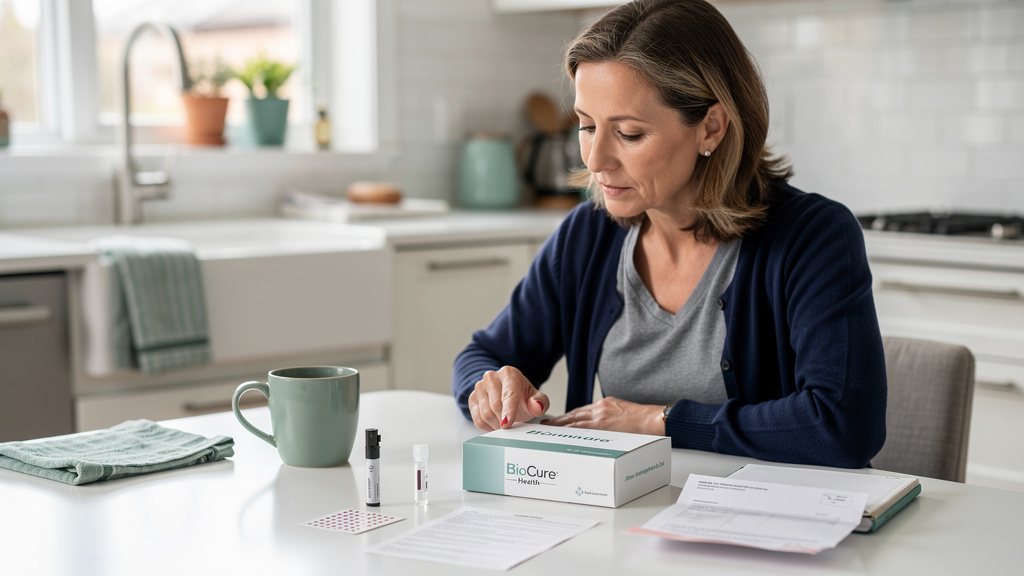
Saliva vs finger-prick vs blood draw: which hormone test is accurate?
For most hormones, no. A venous blood draw analyzed by a certified lab is still the reference standard for testosterone, estradiol, progesterone and thyroid hormones. Finger-prick dried blood spots can be reliable for some markers when the lab has validated them, saliva is mainly useful for cortisol, and urine panels measure hormone breakdown products rather than what is circulating in your blood.
The good news is that "at home" and "blood draw" are no longer opposites. You can get a full venous panel without leaving your house by booking a mobile phlebotomist. That is how BioCure Health diagnostics work: a phlebotomist comes to your home and draws venous blood, or you can choose to test at a lab. The rest of this guide explains which sample type holds up for which hormone, so you can judge any kit before you buy it.
Venous blood draw: the reference standard
A venous draw takes blood from a vein in your arm, and the lab tests the serum or plasma. Nearly every reference range your doctor uses, and the clinical guidelines behind treatment decisions, were built on this kind of sample. When a result is borderline, it is the number clinicians trust.
Volume is the other advantage. A few tubes of venous blood let the lab run a complete picture in one visit: total testosterone, sex hormone binding globulin (SHBG) and albumin to calculate free testosterone, estradiol, LH, FSH, prolactin, TSH, free T4, lipids, metabolic and organ markers. If you want to understand why total and free testosterone tell different stories, read our guide to free testosterone versus total testosterone.
Timing still matters. Testosterone runs highest in the morning, so it is usually drawn early, and a low result is typically confirmed with a second morning test. Progesterone is only meaningful in women when it is timed to the cycle, usually about a week before an expected period. A perfect sample drawn at the wrong time gives you a misleading answer.
Finger-prick dried blood spot: good for some markers, not all
A dried blood spot (DBS) kit asks you to prick a fingertip, drop blood onto a filter card, let it dry, and mail it in. It is convenient and the card is stable in the mail. DBS is not a fringe method either: newborn screening programs have used it for decades.
The limits are practical:
- Small volume. A few drops cannot support as many tests as several tubes of venous blood.
- Collection errors. Squeezing a finger hard can mix tissue fluid into the blood and dilute it. Spots that are too small or overlap can be rejected or misread.
- Conversion. Labs measure hormones in dried whole blood, then convert the result to an estimated serum value. How well that conversion works depends on the marker and on each lab's own validation work.
In practice, DBS can perform reasonably for some markers in some labs and poorly for others, especially hormones present at very low levels. There is no single answer for "finger-prick testing." Before you buy, ask the company which markers on the kit are measured from blood and which from saliva, and whether the lab has published validation data comparing its DBS results with venous results. Retail kits such as Everlywell's women's health test and metabolism test list their sample types on the product page, which is the right place to check.
Saliva: useful for cortisol, unreliable for estradiol and progesterone
Saliva testing is often sold on the idea that it measures the "free," active fraction of a hormone. The problem is that sex hormones appear in saliva at tiny concentrations, and results can be thrown off by food, drinks, toothbrushing, small amounts of blood from the gums and how much saliva you produce. The Endocrine Society and The Menopause Society have both cautioned that saliva testing is not a reliable way to measure estradiol and progesterone or to guide hormone therapy.
This matters most if you use a topical hormone. Saliva levels after a progesterone or estrogen cream can read far higher than what is actually circulating, which can lead to the wrong dose change.
Cortisol is the main exception. Cortisol follows a daily rhythm, and collecting saliva at set times can show that curve. Late-night salivary cortisol is an accepted screening test that endocrinologists use when they suspect cortisol excess.
The FDA's own example of a saliva hormone product is narrow. Its page on the ovulation saliva test describes a test that looks for a ferning pattern in dried saliva as estrogen rises before ovulation. That is a pattern check for timing, not a measurement of your estrogen level.
Urine: dried urine panels measure metabolites
Dried urine panels, such as the DUTCH test, have you soak filter strips with urine at several points across a day. Instead of measuring hormones as they circulate, they measure what your body has broken them down into: estrogen metabolites, pregnanediol (a progesterone metabolite), androgen metabolites, and the daily pattern of cortisol and cortisone.
That can be interesting for questions about how your body processes hormones, and the multi-point collection captures a cortisol pattern. But urine metabolites are not the standard used to diagnose low testosterone, confirm menopause status or adjust thyroid medication, and thyroid hormones are not assessed this way at all. If a clinician is setting or changing a hormone dose, they will almost always want a blood level.
One urine test with a clear, well-established job is the ovulation kit that detects the LH surge. It tells you when, not how much.
Why the lab method matters as much as the sample
Even a perfect venous sample can produce a weak result if the lab uses the wrong method for the situation. Most hospital and commercial labs run hormones on automated immunoassays, which use antibodies to detect the hormone. They are fast and work well in typical adult male testosterone ranges.
They struggle at low concentrations. Endocrine Society position statements on measuring testosterone and estradiol flagged that immunoassays can be inaccurate at the low levels seen in women's testosterone, men's estradiol, postmenopausal women and people taking aromatase inhibitors, and favored liquid chromatography with tandem mass spectrometry (LC-MS/MS) in those cases. LC-MS/MS separates and identifies the hormone by its molecular mass, so it is less prone to cross-reacting with similar molecules.
If you fall into one of those low-level groups, ask which method your lab uses. It is a fair question for any kit company or clinic, including ours.
Hormone by sample type: reliability at a glance
| Hormone | Venous blood | Finger-prick (DBS) | Saliva | Dried urine |
|---|---|---|---|---|
| Total testosterone | Reference standard | Possible if the lab has validated it | Not recommended | Measures metabolites only |
| Free testosterone | Reference (calculated from total T, SHBG, albumin, or measured directly) | Limited | Marketed as "free," not a substitute | Not a blood level |
| Estradiol | Reference; LC-MS/MS preferred at low levels | Weak at low levels | Not recommended by major societies | Measures metabolites only |
| Progesterone | Reference, timed to the cycle | Lab dependent | Not recommended; misleading with creams | Measures pregnanediol, a metabolite |
| TSH and free T4 | Reference standard | TSH possible if lab validated | Not used | Not used |
| Cortisol | Reference for morning cortisol | Limited | Valid for daily curve and late-night screening | Shows daily pattern of metabolites |
| LH and FSH | Reference standard | Lab dependent | Not used | Urine LH kits time ovulation only |
Three ways to get a hormone panel at home
When people ask how to get a hormone panel done at home, there are three real routes. Here is how they compare on sample type, interpretation and how pricing works.
| Route | Examples | Sample type | Interpretation | How pricing works |
|---|---|---|---|---|
| Mail-in kit | Everlywell, LetsGetChecked | Finger-prick blood, saliva or both, depending on the kit | Online report; follow-up support varies by company | Cash price per kit, listed on each product page |
| Consumer-ordered lab test | Labcorp OnDemand, Quest | Venous draw at a patient service center | Online report; limited clinical guidance | Cash price per test or bundle on the company's site |
| Physician-led panel with in-home draw | BioCure Health | Venous draw by an in-home phlebotomist, or in-lab | 1:1 results review with a specialist and a custom protocol | $199 physician consult, credited back with a membership; specialty tests priced individually; HSA/FSA documentation provided |
Mail-in kits are the most convenient if you want a single snapshot and the markers you care about are ones the lab has validated for that sample. Consumer lab orders get you venous accuracy if you are comfortable reading results yourself. Rules for direct-to-consumer lab testing vary by state, so whether you live in Roanoke, Virginia or Fort Lauderdale, check what is available where you are. The FDA's home use tests page is a useful starting point for understanding how home tests are regulated.
BioCure fits people who want venous accuracy without a lab visit and want a physician to act on the results. Our Comprehensive Male and Female panels cover 90+ biomarkers across hormones, thyroid, lipids, metabolic and organ markers. Results arrive in 7 to 14 days, and every result is reviewed with a specialist. We are licensed in 47 states, confirm availability at intake, and do not bill insurance directly. If you only need one quick marker and no follow-up, a consumer lab order may suit you better.
Frequently asked questions
Are saliva hormone tests accurate?
For cortisol, saliva can be useful, and late-night salivary cortisol is an accepted screening test. For estradiol and progesterone, the Endocrine Society and The Menopause Society have cautioned that saliva results are not reliable for guiding treatment. Saliva levels can read especially high if you use a hormone cream.
Is a finger-prick testosterone test as accurate as a blood draw?
It can come close in some labs, but it depends on the lab's validation and on how well you collect the sample. Squeezing the finger or making small spots can skew results. If a finger-prick result is borderline or low, confirm it with a morning venous draw before making any treatment decision.
What is the most accurate way to test hormones at home?
A venous blood draw by a mobile phlebotomist who comes to your home. You get the same sample type labs and guidelines rely on, plus enough blood for a complete panel. BioCure's diagnostics use this in-home venous draw rather than finger-prick collection.
Are at-home hormone test kits FDA approved?
Some home tests are reviewed by the FDA, but many hormone kits are collection kits where you mail a sample and a lab runs the test. The FDA's home use tests page explains how home tests are regulated. For any kit, check which lab processes it and what sample type each marker uses.
Can I check my progesterone with saliva if I use progesterone cream?
It is not a good idea. Topical progesterone can make saliva levels read much higher than what is circulating in your blood, which can lead to the wrong dose change. A timed blood test is the more reliable way to monitor it.
What time of day should I test my testosterone?
Early morning, when testosterone is naturally highest. A single low result is usually confirmed with a second morning test on a different day. Testing in the afternoon can make your level look lower than it really is.
The sample you choose shapes the answer you get. Know which hormone you are measuring, match it to a sample type that is valid for it, and make sure someone qualified reads the result in context.
Let BioCure Health lead you in the right direction. Call or text us to schedule an introductory call at 754-206-0838. Your future self will thank you.