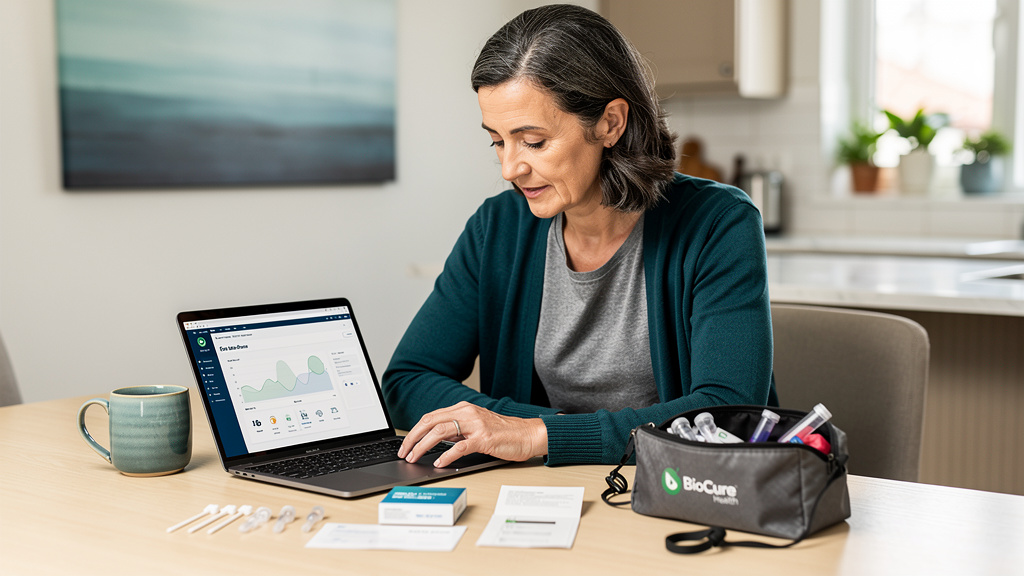
How to get a hormone panel at home: kit, home blood draw, or lab order
You can get a hormone panel at home in three ways: order a mail-in kit and collect a finger-prick blood, saliva or urine sample yourself; book an in-home phlebotomist who draws venous blood from your arm at home; or have a clinician or a direct-access service order the test and visit a local Quest or Labcorp location. Mail-in kits are convenient for a focused screen, while a venous blood draw is the more dependable choice for a broad panel that includes free testosterone, estradiol, SHBG and a full thyroid workup. Whichever route you choose, confirm the lab is CLIA-certified and know who will review your results with you before you order.
A decade ago, most people only did blood work when something felt wrong. Now plenty of people test because they want a baseline, an explanation for low energy, or proof that a protocol is working. The test itself is the easy part. Matching the route to your goal is what makes the numbers useful.
The three routes at a glance
| Route | Sample | Who orders it | Panel breadth | Who interprets | How pricing works |
|---|---|---|---|---|---|
| Mail-in kit (for example Everlywell, LetsGetChecked) | Finger-prick blood, saliva or urine you collect | You buy it online; the company handles authorization | Usually a focused set of markers | Written report; some kits include physician or nurse review | Per kit, cash pay; see each company's product page |
| In-home phlebotomist (for example BioCure Health) | Venous blood drawn at your home | A clinician, after a consultation | Broad: hormones plus thyroid, lipids, metabolic markers | Your clinician, in a results review | Consultation plus panel, cash pay; BioCure provides HSA/FSA documentation |
| Local lab order (Quest, Labcorp) | Venous blood at a patient service center | Your own doctor, or a direct-access service | As broad as what is ordered | Your doctor; direct-access results usually go straight to you | Insurance if your doctor orders it and it is covered; otherwise a la carte cash price per test |
Route 1: Mail-in kit (finger-prick, saliva or urine)
This is the route most people picture, and the one Everlywell and LetsGetChecked are known for. Everlywell, for example, sells a women's health test, a men's health test and a broader hormone health category, with current pricing on those pages. The FDA describes these as direct-to-consumer tests: you buy the test without going through your own provider and get results directly, and the agency encourages you to talk with a healthcare provider about what they mean.
How it works, from order to results:
- Pick the kit that matches your question. Men's health, women's health, thyroid and fertility kits measure different markers. Read the marker list, not just the name.
- Order and register the kit. Most companies ask you to activate the kit online with its barcode so the lab can match your sample to you.
- Time the collection. Testosterone is usually collected in the morning, and some female hormone kits ask for a specific day of your cycle. Follow the instructions exactly.
- Collect the sample. For finger-prick blood, warm your hands, use the lancet on the side of a fingertip and fill the card or tube. For saliva, avoid eating, drinking or brushing your teeth beforehand. Urine kits usually use dried strips.
- Ship it back promptly with the prepaid label, ideally early in the week so it does not sit in transit over a weekend.
- Read your results in the company's online portal once the lab processes the sample.
What to know before you rely on a kit:
- Finger-prick samples are small. If too little blood reaches the card or the sample is damaged, the lab may ask you to recollect.
- Saliva and blood are not interchangeable. MedlinePlus notes that estrogen can be measured in blood, urine or saliva, with blood testing being the most common. Most clinical reference ranges and treatment decisions are built on blood values.
- Most hormone kits are collection kits. The FDA's home use tests page distinguishes tests you complete and read at home from kits you mail to a laboratory. With hormone kits, the quality of the lab matters as much as the kit itself.
Route 2: In-home phlebotomist draw (venous blood)
Here a trained phlebotomist comes to your home or office and draws blood from a vein, the same type of sample you would give at a hospital lab. You get a full lab-grade sample without the waiting room.
The steps:
- Consultation. A clinician reviews your symptoms, goals and medications and decides which markers to run.
- Kit and order. The collection kit is delivered to your home and the lab order is placed.
- Prepare. You may need to fast if lipids or glucose are included. Testosterone is usually drawn in the morning.
- The draw. The phlebotomist fills several tubes, usually in a few minutes, and handles processing and shipping.
- Results review. Your clinician walks through the numbers with you and recommends next steps.
Which markers point toward a venous draw:
- Free testosterone and SHBG, which matter when total testosterone is borderline
- Estradiol in men, which needs a sensitive assay
- LH, FSH and prolactin, which help explain why a hormone is low
- A full thyroid panel with antibodies
- Safety markers such as a complete blood count (including hematocrit), metabolic panel, lipids and PSA
Not every finger-prick kit offers these, and a broad panel needs more blood than a few drops can provide.
How BioCure Health does it. This is the route BioCure diagnostics uses. You complete an online intake of about 5 minutes, then a video consultation with a physician ($199, which can be credited back with a membership). A test kit is delivered to your home and an in-home phlebotomist completes the draw; in-lab testing is also an option. BioCure's Comprehensive Male and Female Panels cover hormones, thyroid, lipids, metabolic and organ markers, a 90+ biomarker panel. Results arrive in 7 to 14 days, and every result is interpreted with a specialist in a 1:1 review. BioCure is licensed in 47 states, confirms availability in your state at intake, and does not bill insurance directly, though many patients use HSA or FSA funds with the invoices BioCure provides.
Route 3: A lab order at Quest or Labcorp
This route is not fully at home, but it is often the fastest. There are two ways in.
- Your own doctor orders it. If the test is medically indicated, insurance may cover part or all of it.
- Direct-access testing. Quest's consumer site and Labcorp OnDemand let you buy a test online. A physician working with the service authorizes the order, and you visit a patient service center for the draw.
The steps for direct access: choose the test, pay online, receive a requisition, book a time at a nearby patient service center, arrive fasted if required, and read results in the portal. People searching for direct-to-consumer lab testing in places like Roanoke, Virginia usually land here, because the large national labs have patient service centers in most metro areas. Direct-access rules vary by state, so check availability where you live before you pay.
The trade-off: you get venous accuracy and wide test menus, but you are choosing the markers yourself, and results often arrive with no one assigned to explain them.
Which route fits your goal
| Goal | Markers usually involved | Best-fit route | Why |
|---|---|---|---|
| Checking for low testosterone | Morning total testosterone, often free testosterone, SHBG, LH, FSH, estradiol, prolactin | Venous draw (home phlebotomist or lab) | Morning timing matters and low results are typically repeated to confirm. A kit can work as a first screen. |
| Monitoring on TRT | Testosterone, estradiol, hematocrit, PSA, lipids, as your prescriber specifies | Venous draw ordered by your prescriber | Safety markers need tracking on a schedule |
| Perimenopause | FSH, estradiol, sometimes progesterone, plus thyroid to rule out look-alikes | Any route, with clinical interpretation | Hormones swing from day to day, so symptoms and cycle changes carry as much weight as one result |
| Thyroid | TSH, free T4, free T3, thyroid antibodies | Finger-prick kit to screen; venous draw for a full workup | TSH is the usual starting point; abnormal results need confirmation |
| Fertility | AMH, FSH, LH, estradiol, often on a specific cycle day | Kit for AMH screening; clinician-ordered venous panel for a full picture | AMH estimates egg supply, not egg quality, and does not predict on its own whether you can conceive |
If your goal is treatment rather than curiosity, start with the route your future prescriber will accept. A clinician considering testosterone therapy, for example, will want confirmed morning venous results.
Who reviews your results, and what happens if something is off
Ask this before you order, not after. Kit companies vary: some send a written report only, while others include a physician or nurse review. Direct-access lab results usually go straight to your portal. With a clinician-led route, the person who ordered the test owns the follow-up.
If a result is abnormal, the usual next steps are:
- Repeat the test under the right conditions, since timing, illness, poor sleep and some supplements can shift results. High-dose biotin, for instance, can interfere with some hormone and thyroid assays.
- Add the markers that explain the result, such as LH and FSH after a low testosterone.
- Decide on treatment, monitoring or referral with a clinician who knows your history.
The FDA's direct-to-consumer guidance makes the same point: a result is information, and decisions about your health should involve a provider.
How to check that the lab is CLIA-certified
Under the Clinical Laboratory Improvement Amendments (CLIA), US labs that test human samples to assess health generally must hold CLIA certification, overseen by the Centers for Medicare and Medicaid Services. Before you order, run through this checklist:
- Ask for the lab's name and CLIA number. Reputable companies list them or provide them on request.
- Look the lab up in the federal CLIA laboratory search to confirm the certificate is active.
- Note any additional accreditation, such as from the College of American Pathologists, as an extra quality signal.
- Confirm the sample type the lab validated for each marker, especially for saliva or finger-prick tests.
- Confirm who reviews results and how you will be contacted about an abnormal value.
Frequently asked questions
Are at-home hormone tests accurate?
They can be, when a CLIA-certified lab processes a properly collected sample. Accuracy drops when a finger-prick sample is too small, collection timing is off, or the hormone is poorly suited to the sample type. For a broad panel or a treatment decision, a venous draw is the more dependable choice.
Is saliva or blood better for hormone testing?
Blood is the standard for most hormone testing. MedlinePlus notes that estrogen can be measured in blood, urine or saliva, but blood is the most common, and most clinical reference ranges are based on blood. Saliva tests are convenient but are harder to compare with the values clinicians use.
Can I check my testosterone level at home?
Yes. You can use a finger-prick kit, book an in-home phlebotomist, or order a test at a local lab. Collect in the morning, and if the result is low, plan on a repeat venous test that adds free testosterone and SHBG before considering treatment.
Do I need a doctor's order for a hormone blood test?
Every lab test needs an authorized order, but you do not always need to arrange it yourself. Kit companies and direct-access services like Labcorp OnDemand use partner physicians to authorize orders, and clinician-led services like BioCure order the panel after your consultation.
Does insurance cover at-home hormone testing?
Most mail-in kits and direct-access tests are cash pay. Insurance is more likely to cover a test your own doctor orders for a medical reason. BioCure does not bill insurance directly, but many patients pay with HSA or FSA funds using the documentation BioCure provides.
A hormone panel is only as good as the sample, the lab and the person reading it. Choose the route that matches your goal, confirm the lab is CLIA-certified, and make sure someone qualified turns the numbers into a plan. Longevity is not accidental, it is intentional. If you want the in-home draw, a broad panel and a physician-led review in one place, reach out to our team.
Let BioCure Health lead you in the right direction. Call or text us to schedule an introductory call at 754-206-0838. Your future self will thank you.