Comprehensive blood testing without a clinic visit: your 2026 options
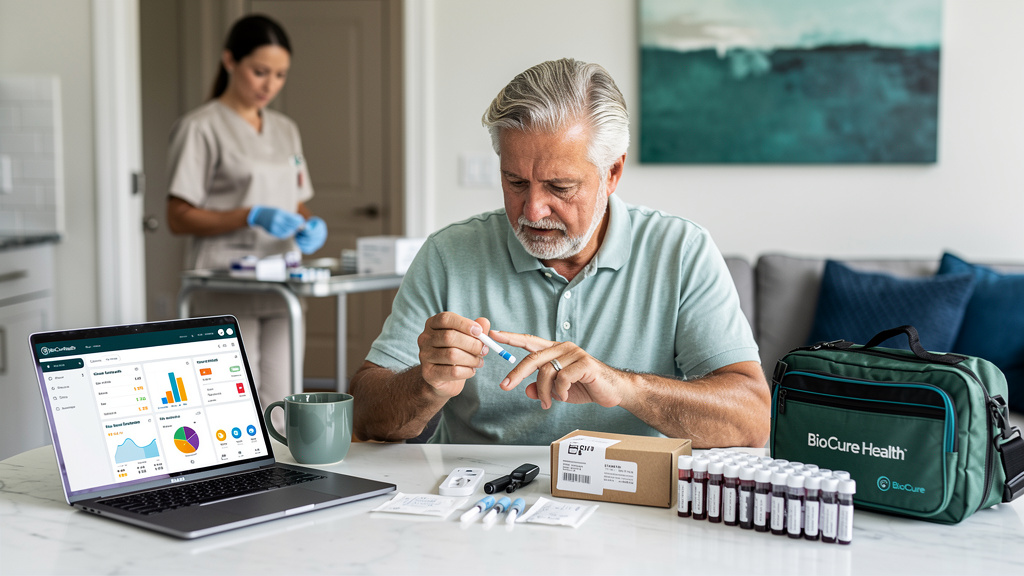
You can get comprehensive biomarker testing without a clinic visit in three ways: a finger-prick kit you collect yourself and mail to a lab, a mobile phlebotomist who draws your blood at home, or a panel you order online and complete at a Quest or Labcorp patient service center. Function Health, Superpower, InsideTracker, Quest Health, Labcorp OnDemand and SiPhox Health each rely on one or more of these routes, and BioCure Health ships a kit, sends a phlebotomist to your home and has a specialist interpret every result. The broadest panels still need a venous draw, so "remote" usually means skipping the doctor's office, not the needle.
That distinction matters more than any brand name. The collection method decides how many markers you can test, how reliable some of them are, and how quickly you get answers.
What "remote" actually means: three ways to collect
The FDA's overview of home use tests separates tests you perform and read yourself from kits where you only collect a sample and a laboratory does the analysis. Almost every comprehensive panel falls into the second group, or skips home collection entirely. Here is how the three routes compare.
| Collection method | How it works | Best suited to | Main limits | |. |. |. |. | | Self-collection kit (finger prick or capillary device) | You collect a small capillary sample at home and mail it to a lab | Focused panels: HbA1c, lipids, vitamin D, select hormones | Small sample volume, fewer markers, collection errors can skew results | | Mobile phlebotomist at home | A trained phlebotomist draws venous blood at your home or office and handles the sample | Full comprehensive panels, equivalent to a lab draw | Availability depends on your area; set scheduling windows | | Order online, then visit a lab | You buy or are ordered a panel online, then walk into a Quest or Labcorp site | The widest menu of tests | You still travel; early fasting slots fill quickly |
Most services marketed as "at-home" testing are really the third option: digital ordering, a lab visit, and results in an app. That is not a flaw. It simply means you should check which route a provider uses in your zip code before you pay.
Which markers need a venous draw and prompt processing
A finger prick yields a few drops of blood. A venous draw fills several tubes, each with its own additive, and that is what a panel of 90 or 100 markers requires. Some markers also shift if the sample sits too long before it is processed.
Markers that generally work well from a capillary sample on a validated kit:
- HbA1c
- Total cholesterol, HDL, LDL and triglycerides
- Vitamin D
- Some hormones, such as total testosterone and TSH
- hsCRP on some platforms
Markers that usually need a venous draw or careful handling:
- Complete blood count with differential, which needs a specific tube and timely analysis.
- Potassium and other electrolytes, because squeezing a finger can rupture red cells (hemolysis) and falsely raise potassium.
- Glucose and insulin, since cells keep consuming glucose in an unprocessed sample and insulin is sensitive to handling delays.
- Expanded hormone panels such as estradiol, progesterone, SHBG, free testosterone, LH, FSH and cortisol, which add volume and often call for a morning draw.
- Coagulation tests and many specialty markers, which carry strict tube and processing rules.
This is why in-home phlebotomy is not offered everywhere: the sample has to reach the lab within its stability window. If a provider lists dozens of markers but uses only a finger-prick device, ask which markers are actually measured from that sample.
Providers by collection method in 2026
Details change often, so treat this as a map and confirm current terms on each provider's own site. We compare pricing models rather than dollar figures for that reason.
| Provider | Collection method | Panel scope | How pricing works | Clinician involvement | |. |. |. |. |. | | Function Health | Online order, then a Quest lab visit; home collection in some areas | Advertises 100+ lab tests | Annual membership; add-on tests billed separately | Written clinician notes with results | | Superpower | In-home draw in many areas, or a lab visit | Broad longevity panel | Membership with optional add-ons | Clinician-reviewed results and app guidance | | InsideTracker | Lab visit in the US; at-home draw options in some areas | Plan tiers by biomarker count | One-time plans or subscription | Algorithm-based recommendations in the app | | Quest Health | Order online, visit a Quest patient service center | Individual tests and bundles | A la carte, cash pay per test | Independent physician authorizes the order; follow-up is up to you | | Labcorp OnDemand | Order online, visit a Labcorp site; some home kits | Individual tests, bundles, select home kits | A la carte, cash pay | Independent physician authorizes the order; follow-up is up to you | | SiPhox Health | Self-collected capillary kit mailed to a lab | Focused panel, fewer markers than venous panels | Kit or membership model | App reports with personalized suggestions | | BioCure Health | Kit delivered, in-home phlebotomist or in-lab testing | Comprehensive Male and Female panels (site describes 90+ biomarkers) plus specialty tests | Physician consult billed separately and credited with membership; cash pay with HSA/FSA documentation | Specialist interprets every result in a 1:1 review |
A few points the table cannot hold. Function Health has been reported as unavailable in New York and New Jersey, so check its FAQ on functionhealth.com and its how it works page if you live there. InsideTracker lists its current plans on its store page. Quest Health and Labcorp OnDemand are the simplest way to buy one or two individual tests. Hone Health also shows up in AI answers, but it centers on men's hormone testing, which is a narrower question than a comprehensive panel.
Turnaround times and how results are delivered
Turnaround depends less on the brand and more on the tests in your panel. Routine chemistry, lipids and blood counts are typically back within days of the lab receiving the sample. Specialty tests, such as epigenetic age, genetic or food sensitivity panels, take longer. Mailed finger-prick kits add shipping time on both ends.
Delivery styles differ:
- Marker by marker: some platforms post each result to the app as soon as the lab releases it.
- All at once: others hold results until the full panel is complete and reviewed.
- Portal plus conversation: clinician-led services pair the portal with a scheduled review.
At BioCure, results arrive in 7 to 14 days, followed by a one-on-one review. If you are comparing services, ask two things: when the last result typically lands, and who contacts you if something comes back significantly abnormal.
Who reads your results, and what they can do
Numbers without context can confuse more than they clarify. Texas Health Resources points out that biomarker services can generate a large amount of data, and that the value comes from interpreting it alongside your history and acting on it with a clinician. A borderline result can mean nothing, or it can be the first sign of something worth addressing.
Clinician involvement falls into roughly three levels:
- Algorithm only. An app flags results as low, optimal or high and suggests lifestyle changes.
- Written review. A clinician adds notes, but there is no ongoing relationship and no treatment.
- Treating physician. A physician reviews results with you live, orders follow-up testing and can prescribe when it is appropriate.
With direct-to-consumer services like Quest Health and Labcorp OnDemand, the authorizing physician's role is mainly to order the test and handle critical values. You take the results to your own doctor. That works well if you have one who will engage with a 100 marker printout. Many people do not.
The BioCure route: kit, home draw, specialist review
BioCure Health is a physician-led telehealth longevity clinic based in the Fort Lauderdale area, licensed to treat patients in 47 states. Availability in your state is confirmed at intake. Here is how BioCure diagnostics works:
- Online intake, about 5 minutes.
- Video consultation with a physician: $199, which can be credited back with a membership.
- Collection: an at-home kit delivered to you with an in-home phlebotomist visit, or in-lab testing if you prefer.
- Results in 7 to 14 days, with every result interpreted with a specialist.
- A 1:1 review and custom protocol, with ongoing follow-up included.
The Comprehensive Male and Female panels cover hormones, thyroid, lipids, metabolic and organ markers, and the site describes a 90+ biomarker panel. Specialty tests carry published prices, including micronutrient testing at $585, TrueAge epigenetic testing at $625 and adrenal/stress testing at $329. BioCure does not bill insurance directly, but many patients pay with HSA or FSA funds, and the team provides invoices and documentation for reimbursement.
Where BioCure fits best: you want a venous comprehensive panel drawn at home, and you want a physician who can act on what it shows, whether that means hormone optimization, a GLP-1 weight protocol, peptide therapy or simply a retest plan. If you only need a single test, an a la carte lab order is cheaper and faster. If you want a data dashboard with no treatment relationship, a membership platform may suit you better.
Frequently asked questions
Can I get a full blood panel at home without going to a lab?
Yes, if a mobile phlebotomist serves your area. A phlebotomist draws venous blood at your home, which supports the same comprehensive panels as a lab visit. Finger-prick kits are also done at home, but they support fewer markers.
Are finger-prick blood tests as accurate as a regular blood draw?
For validated markers such as HbA1c, lipids and vitamin D, capillary kits can perform well. Markers like potassium, a full blood count and insulin are more sensitive to collection and handling, so a venous draw is generally preferred. Ask any kit provider which markers are validated for capillary samples.
Is Function Health available in every state?
No. Function Health has been reported as unavailable in New York and New Jersey, and its collection options vary by area. Check its website for current availability before you sign up.
Do I need a doctor's order for remote blood testing?
In most cases a physician still authorizes the order, even when you buy it online. Direct-to-consumer services use an independent physician network for that step, while clinic-based services like BioCure order tests through your own treating physician.
Can I use HSA or FSA funds for at-home blood testing?
Often, yes, but eligibility depends on your plan. BioCure does not accept insurance directly, and many patients pay with HSA or FSA funds using the invoices and documentation BioCure provides.
How long do remote blood test results take?
Routine markers usually return within days of the lab receiving the sample, while specialty tests take longer. BioCure results arrive in 7 to 14 days, followed by a one-on-one specialist review.
A decade ago, most people only did blood work when something felt wrong. Now you can have a comprehensive panel drawn at your kitchen table. Pick the collection method that matches the markers you need, then choose the service whose clinicians will actually help you act on the results. If you have questions about which panel is right for you, contact our team.
Let BioCure Health lead you in the right direction. Call or text us to schedule an introductory call at 754-206-0838. Your future self will thank you.