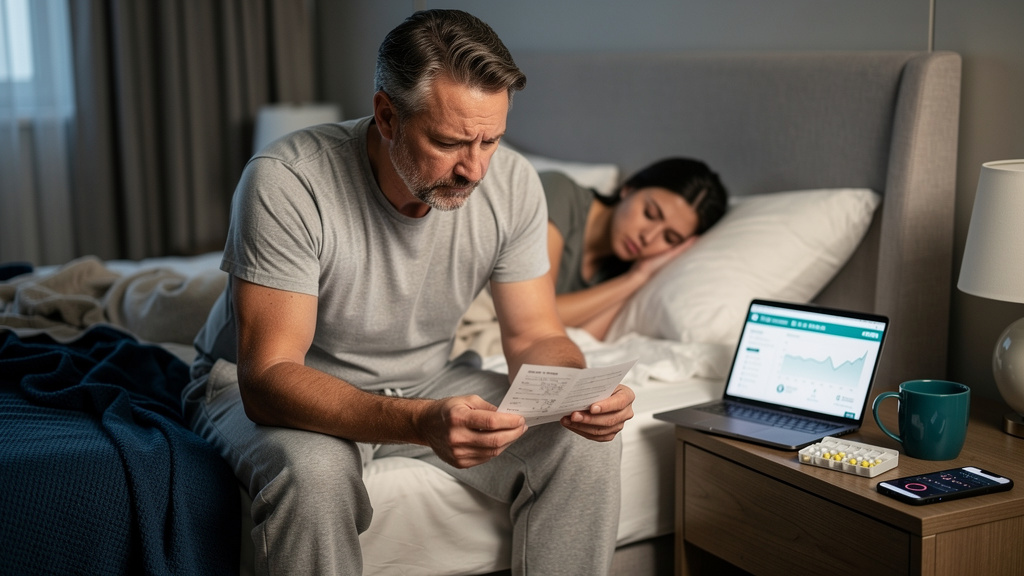
Low T symptoms vs normal aging, stress or poor sleep: how to tell
You cannot reliably tell low testosterone apart from normal aging, stress or poor sleep by how you feel. A handful of signs point more specifically to low T: lower sex drive, fewer morning erections, breast tenderness or enlargement, loss of body hair, very small testes and hot flushes. Fatigue, low mood, poor focus and weight gain are just as likely to come from depression, thyroid disease, sleep apnea, anemia, alcohol or a medication. The only way to know is a blood test: at least two early morning testosterone measurements that are consistently low, read alongside tests that rule out the lookalikes.
That is the standard set by the Endocrine Society's 2018 clinical practice guideline (Bhasin et al., Journal of Clinical Endocrinology and Metabolism), which recommends diagnosing male hypogonadism only when symptoms are present and serum testosterone is unequivocally and consistently low. MedlinePlus and Mayo Clinic say the same thing in plain terms. Here is how to sort out what your symptoms are actually telling you.
Signs that point more specifically to low testosterone
Some symptoms are hard to explain any other way. The Endocrine Society guideline groups these as the more specific signs of testosterone deficiency:
- Reduced sex drive and less sexual activity. Desire is the symptom most closely tied to testosterone.
- Fewer spontaneous or morning erections. Waking erections depend partly on testosterone.
- Breast tenderness or enlargement (gynecomastia).
- Loss of body hair, including underarm and pubic hair, or needing to shave less often.
- Very small or shrinking testes.
- Hot flushes and sweats, which in men usually suggest very low levels.
- Low sperm count or trouble conceiving.
Even these are not proof. Low libido can come from relationship strain, an antidepressant or depression itself. Erection problems often have vascular causes, such as diabetes or high blood pressure, with perfectly normal testosterone. But if you have several of these signs, especially body hair loss or changes in the testes, low T moves much higher on the list.
Signs that overlap with aging, stress and poor sleep
The second group is what most men notice first, and it is the least useful for diagnosis. The guideline lists low energy, depressed mood, poor concentration and memory, sleep disturbance, increased body fat, reduced muscle bulk and strength, and mild anemia as less specific signs. Each has a long list of other explanations.
| Symptom | How strongly it points to low T | Other common explanations |
|---|---|---|
| Low sex drive | Strongly | Depression, SSRIs, relationship stress, high prolactin |
| Fewer morning erections | Strongly | Vascular disease, diabetes, poor sleep |
| Breast tenderness or enlargement | Strongly | Certain medications, liver disease, anabolic steroid use |
| Loss of body hair, less shaving | Strongly | Thyroid disease, some skin conditions |
| Very small testes | Strongly | Needs evaluation regardless of cause |
| Hot flushes in men | Strongly | Anxiety, overactive thyroid, infection, medications |
| Fatigue | Weakly | Short sleep, sleep apnea, anemia, hypothyroidism, depression, overtraining |
| Low mood | Weakly | Depression, chronic stress, alcohol |
| Poor concentration | Weakly | Sleep loss, depression, thyroid disease |
| Weight gain | Weakly, and it runs both ways | Diet, activity, hypothyroidism, medications; excess body fat itself lowers testosterone |
| Lower strength | Weakly | Aging, under or overtraining, low protein intake |
Testosterone does tend to decline gradually with age. So do energy, recovery and muscle mass, for reasons that often have nothing to do with hormones. Age by itself is not a diagnosis, and a number on a lab report is not either. You need both pieces.
Common lookalikes, and which ones actually lower testosterone
Some conditions only mimic low T. Others genuinely lower it, which means treating the cause can bring the number back up. This distinction matters: treating the testosterone while ignoring the cause leaves the real problem in place.
| Condition | Symptoms it mimics | Can it lower testosterone? | How it is checked |
|---|---|---|---|
| Depression | Low mood, low libido, fatigue, poor focus | Mainly mimics | Clinical screening and history |
| Hypothyroidism | Fatigue, weight gain, low mood | Mainly mimics | TSH |
| Obstructive sleep apnea | Fatigue, poor focus, low libido | Yes, linked to lower levels | Sleep study |
| Iron deficiency or anemia | Fatigue, low exercise tolerance | No, though low T can cause mild anemia | CBC, ferritin |
| Iron overload (hemochromatosis) | Fatigue, low libido | Yes | Ferritin, iron studies |
| Overtraining or underfueling | Fatigue, low libido, lost strength | Yes, can suppress it | Training and diet history |
| Heavy alcohol use | Low mood, poor sleep, sexual problems | Yes | History, liver tests |
| Opioids or glucocorticoids | Fatigue, low libido | Yes, can suppress it | Medication review |
| SSRIs | Low libido, erection or orgasm problems | No; the effect is on sexual function | Medication review |
| Obesity and type 2 diabetes | Fatigue, weight gain | Yes, linked to lower levels | Hemoglobin A1c, glucose |
When testosterone is low, the cause sits in one of two places. Primary hypogonadism starts in the testes, from injury, infection such as mumps, chemotherapy or radiation, genetic conditions like Klinefelter syndrome, or hemochromatosis. Secondary hypogonadism starts in the pituitary gland or hypothalamus, from pituitary tumors, opioid or steroid use, obesity, serious illness or rapid weight loss, according to MedlinePlus. Knowing which one you have changes the treatment options.
Sleep deserves its own mention, because it is both a lookalike and a cause. Short sleep and sleep apnea are linked to lower testosterone, and the Endocrine Society guideline lists untreated severe sleep apnea as a reason not to start testosterone therapy. Our post on why rest is the reset button for your hormones covers this in more depth.
The ADAM questionnaire, and why it flags so many men
The Androgen Deficiency in Aging Males (ADAM) questionnaire is a 10 question yes or no screen that shows up in online quizzes and intake forms. It asks about libido, energy, strength, height loss, enjoyment of life, mood, erection strength, sports performance, falling asleep after dinner and work performance. A result counts as positive if you answer yes to the libido or erection question, or to any three of the others.
The problem is that most of those questions describe being tired, busy and over 40. Tools like ADAM were built to be sensitive, so they catch most men with low T. The tradeoff is low specificity: they also flag many men whose testosterone is normal. A positive score tells you very little on its own.
That is one reason the Endocrine Society guideline recommends against routinely screening men in the general population for low testosterone, and why it ties the diagnosis to confirmed blood levels rather than a symptom score. Use ADAM as a conversation starter, not a verdict.
What to test to separate low T from everything else
The point of testing is not just to get a testosterone number. It is to rule the lookalikes in or out at the same time.
| Test | What it answers | When it is used |
|---|---|---|
| Total testosterone, morning, fasting, repeated | Is testosterone truly and consistently low? | Everyone being evaluated; confirm on a second morning |
| Free testosterone | Is the usable fraction low? | Borderline totals, obesity, aging or abnormal SHBG |
| LH and FSH | Is the problem in the testes or the pituitary? | When testosterone is low |
| TSH | Is the thyroid behind the fatigue or weight gain? | Routinely alongside hormones |
| CBC | Is there anemia? Baseline before any therapy | Routinely |
| Ferritin or iron studies | Iron deficiency or iron overload? | Fatigue, low T, or a family history of hemochromatosis |
| Hemoglobin A1c | Prediabetes or diabetes? | Routinely, especially with weight gain |
| Prolactin | Possible pituitary issue? | Low T with low or normal LH, or pituitary symptoms |
| Sleep study | Sleep apnea? | Snoring, witnessed pauses in breathing, daytime sleepiness |
| Semen analysis | Sperm production | If fertility matters to you |
Why the morning, and why twice? Testosterone peaks in the morning and varies from day to day, so a single afternoon result can look falsely low. The guideline recommends a morning fasting sample, confirmed with a repeat, and advises against testing during an acute illness. It cites a harmonized lower limit of normal of about 264 ng/dL for total testosterone in healthy, nonobese young men, while noting that each lab's reference range matters. Mayo Clinic adds that pituitary imaging or genetic testing may follow when results point that way.
At BioCure, this kind of workup is the first step, not an afterthought. Our comprehensive male panel checks hormones alongside thyroid, lipid, metabolic and organ markers in one draw, part of what we describe as a 90+ biomarker panel, so the lookalikes are screened at the same time as testosterone. You can use an at-home kit with an in-home phlebotomist visit or test at a lab, and results come back in 7 to 14 days. A physician then reviews them with you one on one. The video consultation is $199, which can be credited back with a membership.
If your results confirm low T, our testosterone program has three tiers: bioOptimize as a foundation, bioRestore to raise your body's own production without direct hormone replacement, and bioTest for full replacement with ongoing monitoring. If your results point to thyroid, iron, blood sugar or sleep instead, that is what gets addressed. Longevity is not accidental, it is intentional, and it starts with knowing the actual cause.
When to see a doctor sooner
Most low energy can wait for a planned workup. Some signs should not, and they deserve a prompt in-person evaluation:
- Infertility or trouble conceiving. Testosterone therapy suppresses sperm production, so the order of testing and treatment matters.
- New breast enlargement, especially if it is one-sided, painful or has a lump.
- Headaches, vision changes or milky nipple discharge, which can signal a pituitary tumor.
- Very small or shrinking testes, or a testicular lump.
- A low-trauma fracture or noticeable height loss.
- Symptoms that began in your teens or twenties, or after a head injury.
Frequently asked questions
Can I tell if I have low testosterone without a blood test?
No. Symptoms like fatigue, low mood and weight gain overlap with sleep apnea, thyroid disease, depression and anemia. Guidelines require consistently low testosterone on at least two morning blood tests, together with symptoms, before diagnosing low T.
What time of day should testosterone be tested?
Early morning, ideally fasting, because levels peak in the morning and dip later in the day. The Endocrine Society recommends confirming a low result with a second morning test and avoiding testing during an acute illness.
Can poor sleep cause low testosterone?
Yes. Short sleep and obstructive sleep apnea are both linked to lower testosterone, and improving sleep may help. Untreated severe sleep apnea is also a reason not to start testosterone therapy, so a sleep study may come first.
What causes low testosterone in men?
Low T comes either from the testes (primary), due to injury, infection, chemotherapy, genetic conditions or iron overload, or from the pituitary and hypothalamus (secondary), due to tumors, opioid or steroid use, obesity or serious illness. LH and FSH blood tests help tell the two apart.
Is low testosterone just a normal part of aging?
Testosterone does decline gradually with age, but age alone is not a diagnosis. Diagnosis needs symptoms plus consistently low morning levels, and the Endocrine Society advises against routinely prescribing testosterone to all men over 65 with low levels, favoring an individual decision instead.
Do antidepressants lower testosterone?
SSRIs commonly cause low libido and sexual side effects, but they generally do not lower testosterone itself. Opioids and glucocorticoids, on the other hand, can suppress testosterone production, which is why a medication review is part of any workup.
The question is not whether you feel like you have low T. It is what is actually driving how you feel, and that answer lives in your blood work, your sleep and your history. Test properly once, and you stop guessing.
Let BioCure Health lead you in the right direction. Call or text us to schedule an introductory call at 754-206-0838. Your future self will thank you.