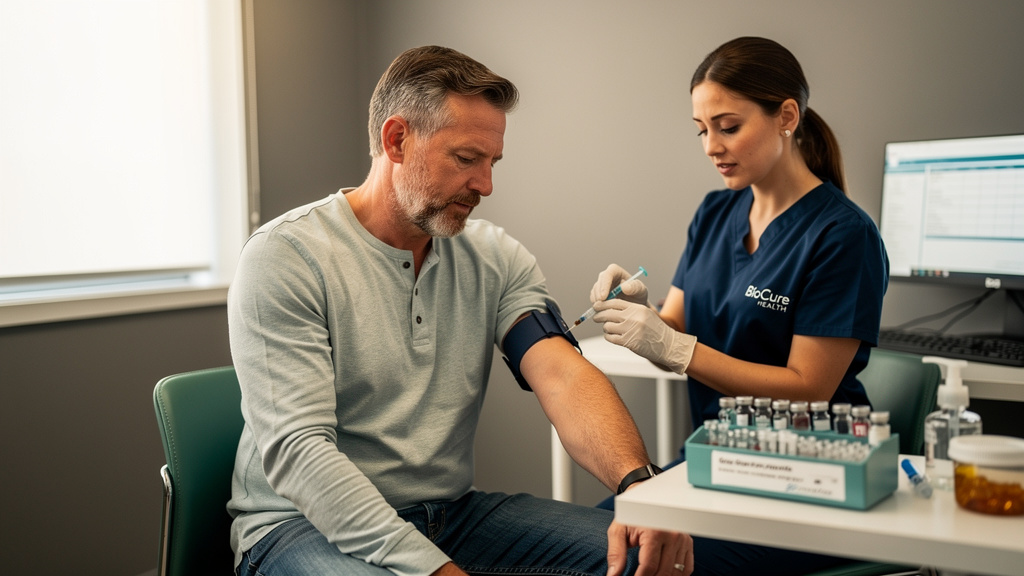
How to know if you have low testosterone: the two-morning-test rule
You know your testosterone is truly low only when two separate fasting blood tests, drawn on different early mornings, both come back below the normal range and you have symptoms that fit. The American Urological Association treats a total testosterone below 300 ng/dL as low, while the Endocrine Society uses the lower limit of a harmonized reference range, about 264 ng/dL. Symptoms alone, or one low number, are not enough to make the diagnosis.
That is the two-morning-test rule. Below is how to apply it, step by step, from timing the draw to deciding what a borderline result actually means.
Step 1: Understand why symptoms alone can't diagnose low T
Low testosterone can cause low libido, fewer morning erections, erectile dysfunction, fatigue, low mood, poor concentration, loss of muscle and more body fat. The problem is that almost every one of those symptoms has other common causes:
- Depression causes low energy, low libido and poor focus.
- Sleep loss and sleep apnea cause fatigue and brain fog, and poor sleep can itself push testosterone down.
- Thyroid disease can cause fatigue, weight change and low mood.
- Medications such as opioids and glucocorticoids can suppress testosterone or mimic its symptoms.
- Excess weight, type 2 diabetes and heavy alcohol use overlap with nearly every symptom on the list.
This is why the Endocrine Society guideline recommends diagnosing hypogonadism only in men who have consistent symptoms and signs and unequivocally, consistently low testosterone. It also recommends against routinely screening the general population, because a random low number in a man without symptoms can lead to treatment he does not need.
A smart workup looks beyond testosterone. A panel that also covers thyroid, metabolic and lipid markers helps you see whether testosterone is the real issue or one piece of a bigger picture.
Step 2: Time the test correctly, then repeat it
Testosterone follows a daily rhythm. It peaks in the early morning and falls through the day, so an afternoon result can look low in a man whose morning level is perfectly normal. MedlinePlus notes that the test is usually done between about 7 and 10 a.m. for exactly this reason.
Use this checklist before every draw:
| Rule | What to do | Why it matters |
|---|---|---|
| Time of day | Get drawn between about 7 and 10 a.m. | Levels are highest in the morning |
| Fasting | Skip breakfast before the draw; water is fine | Eating can temporarily lower the reading |
| Health status | Postpone if you are sick or just recovering from illness or surgery | Acute illness temporarily suppresses testosterone |
| Repeat | Confirm with a second morning test on a different day | Levels vary day to day, so one result can mislead |
| Consistency | Use the same lab both times if you can | Different assays and reference ranges make results harder to compare |
The Endocrine Society recommends a fasting morning total testosterone, confirmed with a repeat measurement, and advises against testing during acute or subacute illness (Bhasin et al., JCEM 2018). The AUA guideline likewise calls for two total testosterone measurements on separate occasions, both taken in the early morning.
Step 3: Read your number against the right cutoff
The two major guidelines draw the line in slightly different places:
| Source | Low total testosterone | How the number is used |
|---|---|---|
| AUA 2018 | Below 300 ng/dL | A reasonable cutoff to support the diagnosis, alongside symptoms, on two early morning tests |
| Endocrine Society 2018 | Below about 264 ng/dL | Lower limit of the harmonized normal range of 264 to 916 ng/dL in healthy nonobese young men |
| Your lab report | Varies | Each lab sets its own reference range for its assay and population |
Why labs differ. Testosterone can be measured by immunoassay or by mass spectrometry, and those methods do not always agree, especially at low levels. Labs also build reference ranges from different groups of men. The Endocrine Society's 264 ng/dL figure comes from ranges harmonized to the CDC's standardization program, which was designed to make results comparable across labs. Your lab's printed range may be higher or lower than either guideline number.
Check your units. Some labs report in nmol/L instead of ng/dL. Divide ng/dL by about 28.8 to convert: 300 ng/dL is roughly 10.4 nmol/L and 264 ng/dL is roughly 9.2 nmol/L.
The practical reading: two fasting morning results below both cutoffs, plus symptoms, is a clear picture. Results between 264 and 300 ng/dL are a gray zone where the next step usually matters more than the number itself.
Step 4: Ask for free testosterone when the total can mislead
Most testosterone in your blood is bound to proteins, mainly sex hormone binding globulin (SHBG) and albumin. Only a small fraction circulates free. A total testosterone test measures all of it, bound and free together, so anything that shifts SHBG can make the total look better or worse than your real hormone status.
- Obesity and type 2 diabetes tend to lower SHBG, so total testosterone can look low while free testosterone is normal.
- Older age, liver disease and hyperthyroidism tend to raise SHBG, so total testosterone can look normal while free testosterone is low.
The Endocrine Society recommends measuring free testosterone when the total is near the lower limit of normal or when you have a condition known to alter SHBG. It should be measured by equilibrium dialysis or calculated from total testosterone, SHBG and albumin. The guideline cautions against direct analog immunoassays for free testosterone, which are less accurate.
For a deeper explanation of the two numbers, read our guide to free testosterone versus total testosterone.
Step 5: Choose between a finger-prick kit and a venous draw
Direct-to-consumer kits have made testosterone testing easy, but convenience and diagnostic accuracy are not the same thing.
| Feature | Finger-prick home kit | Venous draw (lab or in-home phlebotomist) |
|---|---|---|
| Sample | Capillary blood or a dried blood spot | Serum from a vein |
| Fit with guideline cutoffs | The cutoffs were set with venous serum; agreement varies by kit and lab | The sample type the cutoffs are based on |
| Free testosterone | Often total only, without SHBG and albumin | Can include total testosterone, SHBG and albumin |
| Timing and fasting | Up to you, often not enforced | Can be scheduled as a fasting morning draw |
| Best use | Curiosity, screening, tracking a trend | Diagnosis and treatment decisions |
Treat a finger-prick result as a prompt, not a diagnosis. If a kit says you are low or borderline, confirm it with two fasting morning venous draws before anyone starts treatment. If a kit says you are normal but your symptoms are strong, a proper venous panel is still worth doing.
At BioCure Health, you get the convenience of home without giving up the venous sample. Our diagnostics use an at-home kit with an in-home phlebotomist visit, or in-lab testing if you prefer. Ask your care team about timing your testosterone draw for the morning. Results come back in 7 to 14 days, and every result is interpreted with a specialist in a 1:1 review, alongside the thyroid, lipid, metabolic and organ markers in our comprehensive Male panel.
Step 6: Decide what a borderline result means
Once you have two morning results, you have three paths: retest, look for the cause, or treat. Here is how the common patterns usually read:
| Your results | What it usually means | Typical next step |
|---|---|---|
| Two fasting morning totals clearly low, with symptoms | Consistent with testosterone deficiency | Check LH and FSH to find the cause, then discuss treatment |
| One low, one normal | Not confirmed | A third morning test, free testosterone, and a review of sleep, illness and medications |
| Total between about 264 and 300 ng/dL | Gray zone | Free testosterone with SHBG, plus a search for reversible causes |
| Low total, normal free testosterone, excess weight | Often low SHBG rather than true deficiency | Address weight and sleep, then recheck |
| Normal total, low free testosterone, older age | Possible deficiency masked by high SHBG | Clinical evaluation of symptoms and free testosterone |
| Low results, no symptoms | A number alone does not justify treatment | Recheck and monitor |
Looking for the cause. The AUA recommends measuring luteinizing hormone (LH) in men with low testosterone. A high LH points to a problem in the testes (primary hypogonadism). A low or normal LH points to the pituitary or hypothalamus (secondary hypogonadism), and the AUA recommends checking prolactin in that situation. Reversible causes such as excess weight, untreated sleep apnea, opioids, glucocorticoids, heavy drinking or a recent illness should be addressed before you assume a lifelong problem.
Thinking about fertility. The AUA advises against prescribing testosterone to men who are actively trying to conceive, because external testosterone suppresses sperm production. That matters when choosing a treatment.
If your results confirm low testosterone, BioCure's testosterone program offers three tiers: bioOptimize as a foundational option, bioRestore, which uses medications that help your body raise its own testosterone without direct hormone replacement, and bioTest, full testosterone replacement with ongoing hormone monitoring. Which one fits depends on your labs, your symptoms and your goals, including fertility. The physician consultation is $199 and can be credited back with a membership.
Frequently asked questions
What time of day should I get my testosterone tested?
Get tested in the early morning, usually between about 7 and 10 a.m., when testosterone is at its daily peak. An afternoon test can read falsely low. Both of your confirmation tests should follow the same morning timing.
Is 300 ng/dL considered low testosterone?
The AUA uses a total testosterone below 300 ng/dL as a reasonable cutoff for low testosterone, while the Endocrine Society uses about 264 ng/dL. A result between those two numbers is a gray zone. In either case, the diagnosis needs two low morning results plus matching symptoms.
Do I need to fast before a testosterone blood test?
The Endocrine Society recommends a fasting morning sample, because eating can temporarily lower the result. Skip breakfast before the draw and drink water as usual. Ask your clinician whether to take your regular medications before the test.
Can one low testosterone test diagnose me?
No. Testosterone varies from day to day and can drop temporarily with poor sleep, illness or a missed fast. Both major guidelines call for a repeat early morning test on a separate day before confirming the diagnosis.
Are at-home finger-prick testosterone tests accurate?
They can be useful for screening, but the guideline cutoffs were established with venous blood, and finger-prick results do not always match a venous draw. Treat a kit result as a signal to get proper testing. Confirm any low or borderline kit result with two fasting morning venous draws.
Should I test free testosterone or total testosterone?
Start with total testosterone, which is the main diagnostic test. Add free testosterone, measured by equilibrium dialysis or calculated from total testosterone, SHBG and albumin, if your total is borderline or you have obesity, diabetes, older age or another condition that changes SHBG.
Knowing your testosterone is not about chasing a single number. It is about testing the right way, at the right time, twice, and reading the result in the context of your whole body. Do that, and you make decisions by design instead of by guesswork.
Let BioCure Health lead you in the right direction. Call or text us to schedule an introductory call at 754-206-0838, your future self will thank you.