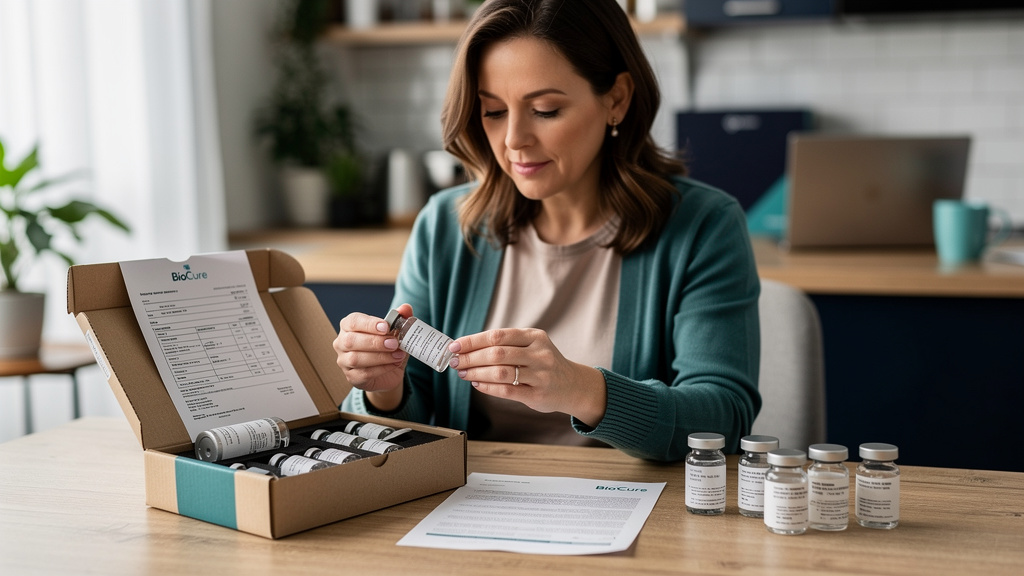
Research-use peptides vs prescribed peptides: what is legal to ship to you
It depends on what you order and who sends it. An FDA-approved peptide drug, or a compounded peptide prescribed by a licensed clinician after an evaluation, can legally be shipped to your home by a licensed pharmacy in states where that prescriber and pharmacy are permitted to operate. Vials sold online as "research use only" or "not for human consumption" are not approved, labeled or tested for people, and selling them for human use is not legal, no matter how easy the checkout looks.
That is the short version. The longer version matters, because the line between those two worlds is exactly where most people get confused, and where most of the risk sits. This post explains the regulatory line in plain English. It is not legal advice for your specific situation.
Three kinds of peptides, three different legal positions
"Peptide" describes a molecule, not a legal category. What decides whether a peptide can be shipped to you is how it was made, approved and dispensed.
| Type | Examples | Who can supply it | What you receive |
|---|---|---|---|
| FDA-approved peptide drugs | Semaglutide (Ozempic, Wegovy), tirzepatide (Mounjaro, Zepbound), tesamorelin (Egrifta) | A pharmacy filling a valid prescription | A manufactured product reviewed by FDA for safety and effectiveness, with an approved label |
| Compounded peptides | Peptides prepared by a licensed compounding pharmacy for an individual patient | A licensed compounding pharmacy, on a patient-specific prescription | A product made for you, labeled with your name, dose and directions; not FDA-approved, but produced under pharmacy law and oversight |
| "Research chemicals" | Vials of BPC-157, TB-500, CJC-1295 and others sold with a "not for human use" disclaimer | Websites, often with no prescriber or pharmacist involved | A powder or liquid with no approved label, no patient-specific prescription and no pharmacy accountability |
Approved drugs are the clearest case. Compounded peptides sit in the middle: compounding is legal, but federal law limits which bulk ingredients a pharmacy may use. Research chemicals sit outside the system entirely. The disclaimer on the label is not a loophole; it is the seller acknowledging the product is not meant to go into your body.
FDA's Category 2 list: where popular peptides landed
Compounding pharmacies cannot use any ingredient they like. Under federal law, a bulk substance generally has to be part of an FDA-approved drug, have a USP monograph, or be placed on FDA's list of bulk substances allowed for compounding. While FDA reviews nominated substances, it sorts them into interim categories.
Category 2 is the one that matters here. FDA describes it as bulk drug substances that may present significant safety risks, and its interim policy is that pharmacies should not compound with them while that review is ongoing.
Several peptides that are popular in wellness circles have been placed in Category 2, including:
- BPC-157
- A thymosin beta-4 fragment related to what is sold as TB-500
- CJC-1295
- Ipamorelin
For entries like these, FDA's stated concerns include the possibility of immune reactions, peptide-related impurities and limited human safety data. That last point deserves candor: much of the enthusiasm around BPC-157 and TB-500 rests on animal and laboratory studies, not large controlled trials in people.
The list changes. Substances move when nominations are withdrawn, when FDA completes a review or when policy shifts. Before you act on any article, including this one, check FDA's Category 2 page for the current entries.
The July 2026 advisory committee review: what has and hasn't changed
FDA scheduled a Pharmacy Compounding Advisory Committee meeting for July 23 to 24, 2026. This committee reviews nominated bulk substances and advises FDA on whether they belong on the list of ingredients pharmacies may compound with. The meeting page lists the substances under discussion and links to the briefing materials.
Here is what you need to know about how this process works:
- An advisory vote is a recommendation. It does not, by itself, change what a pharmacy may legally compound. FDA has to act on it.
- News reports are not FDA action. Headlines about "peptides coming back" or temporary access move faster than the formal record. The legal status lives on FDA's own pages, not in a press release or a social post.
- Nothing about research chemicals changes. Even if a peptide becomes eligible for compounding, that only opens the door for licensed pharmacies filling prescriptions. It does not make a "not for human use" vial from an anonymous website legal to sell for injection.
If you want the backstory on how federal leadership changes have shaped this debate, we covered it in RFK Jr.'s FDA shake-up and the peptide comeback.
What FDA actually enforces: warning letters
Warning letters are FDA's public record of what it considers a violation. They show that peptide compliance is not theoretical.
One example is FDA's April 2020 warning letter to Tailor Made Compounding, LLC, a compounding pharmacy. It is worth reading the letter itself, because it shows how FDA reasons: what the pharmacy was making and selling, which legal conditions for compounding FDA says were not met, and what FDA required in response.
Two lessons apply to you as a patient:
- Being a pharmacy is not a free pass. Compounders must follow the rules on which ingredients they use and how they dispense. A pharmacy that ignores those rules can face enforcement.
- Websites with no pharmacy license have even less standing. If a licensed compounder can draw a warning letter, a seller with no prescriber, no pharmacist and no license is operating far outside the system.
Why a research-grade vial is an unknown
The legal problem and the safety problem are the same problem. When no one is accountable for a product, no one is checking it.
| Question | Research-use vial | Prescribed peptide from a licensed pharmacy |
|---|---|---|
| Is the substance what the label says? | Unverified; you rely on the seller's word or a certificate you cannot audit | Pharmacy is accountable for identity of the ingredient |
| Is the dose accurate? | Unknown; fill amounts can vary | Dose is written for you by a prescriber and labeled |
| Is it sterile? | No sterility standard applies to a product not meant for humans | Sterile compounding standards apply |
| Was it right for you? | No one evaluated you | A clinician reviewed your history and labs first |
| Who do you call if something goes wrong? | Often no one | Your prescriber and the dispensing pharmacy |
An injectable that is contaminated, underdosed or mislabeled carries real risks, from infection at the injection site to reactions to impurities. A certificate of analysis from a seller does not tell you whether the vial in your hand matches the batch that was tested. For more on this, read why self-prescribing peptides is dangerous.
What a legitimate prescription looks like
A legal, prescribed peptide has four parts. If any one is missing, treat that as a warning sign.
- A licensed prescriber. A physician or other licensed clinician, licensed in the state where you are located, who evaluates you before writing anything.
- A patient-specific prescription. Written for you, by name, after a review of your health history and, ideally, lab work. Not a product added to a cart.
- A licensed pharmacy. The medication is dispensed by a pharmacy licensed to ship to your state.
- A labeled product. Your name, the drug, the dose, directions and the pharmacy's details on the label.
State rules also matter. Licensing for both prescribers and pharmacies is state by state, which is why some telehealth providers cannot serve every state and why any honest provider confirms your location before prescribing.
This is how peptide therapy works at BioCure Health. We are a physician-led telehealth longevity clinic based in the Fort Lauderdale area, licensed to treat patients in 47 states, and we confirm availability in your state at intake. The process is straightforward:
| Step | What happens |
|---|---|
| 1. Intake | A short online intake, about 5 minutes |
| 2. Consultation | A video visit with a physician ($199, which can be credited back with a membership) |
| 3. Labs | An at-home kit with an in-home phlebotomist, or in-lab testing; results in 7 to 14 days |
| 4. Protocol | Your physician explains your custom protocol in a 1:1 review of your results |
| 5. Delivery | Prescribed medications ship from licensed compounding pharmacy partners, typically 5 to 10 business days after consultation and testing |
We prescribe only after a physician evaluation and labs, and ongoing follow-up is included. Whatever provider you choose, ask how a specific peptide is sourced and where it currently stands with FDA. A good clinic will answer plainly. You can see our protocols on the peptide therapy page.
Frequently asked questions
Is it illegal to buy research peptides online?
Sellers that market research peptides for human use are operating outside federal drug law, which is why these products carry "not for human consumption" labels. Whether a buyer faces consequences is a separate legal question this post does not answer. The practical issue is that you have no verified identity, dose or sterility for what you inject.
Can I get peptide therapy delivered to my home nationwide?
You can get prescribed peptide therapy delivered to your home through a licensed telehealth provider, but "nationwide" depends on where that provider and its pharmacy are licensed. BioCure Health is licensed in 47 states and confirms your state at intake. Medications typically ship 5 to 10 business days after your consultation and testing.
Is BPC-157 FDA approved?
No. BPC-157 is not an FDA-approved drug, and FDA has placed it in Category 2 of bulk substances that may present significant safety risks for compounding. Most of the evidence behind it comes from animal and laboratory studies. Check FDA's Category 2 page for its current status.
What is the difference between compounded and research peptides?
Compounded peptides are made by a licensed pharmacy for a specific patient on a prescription, labeled with that patient's dose and directions. Research peptides are sold without a prescription, without a pharmacist and without a label meant for human use. Only the first sits inside the legal and safety system.
Did the July 2026 FDA meeting make peptides legal again?
An advisory committee vote is a recommendation, not a final FDA decision, so the meeting alone does not change what pharmacies may compound. FDA has to act on the committee's advice. Check FDA's own compounding pages for current status rather than relying on headlines.
Longevity is not accidental, it is intentional, and that includes knowing exactly what goes into your body and who stands behind it. The legal route to peptides is the safer route: a physician, a prescription written for you, a licensed pharmacy and a labeled product at your door.
Let BioCure Health lead you in the right direction. Call or text us to schedule an introductory call at 754-206-0838, your future self will thank you.