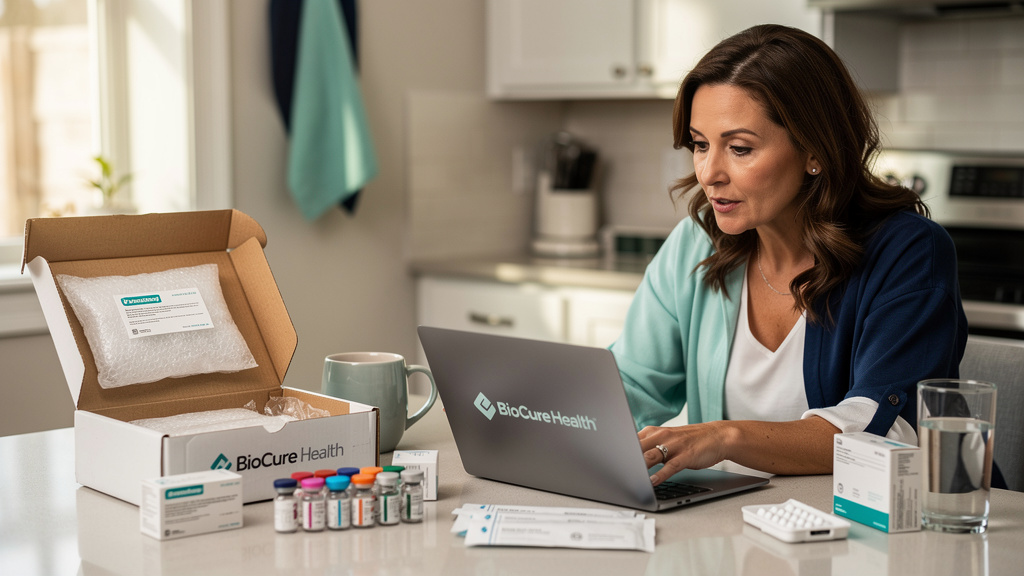
How to get peptide therapy shipped to your home: the 5-step telehealth process
Yes. In most US states you can start peptide therapy through a telehealth visit and have it shipped to your home, as long as the prescriber is licensed in the state where you are located and the pharmacy is licensed to ship there. The process runs in five steps: a physician evaluation, baseline labs, a prescription filled by a licensed pharmacy, cold-chain delivery, and at-home administration with follow-up monitoring. What "nationwide" really means depends on your state, the clinic's licenses and the specific peptide, because FDA has flagged some compounded peptides, including BPC-157, as potential safety risks.
Here is how each step actually works, what can go wrong, and what to ask before you sign up anywhere.
The five steps at a glance
| Step | What happens | What you should confirm | Timing at BioCure |
|---|---|---|---|
| 1. Physician evaluation | Review of your history, medications, goals and risks | The prescriber is licensed in your state | About 5 minutes of online intake, then a video consult |
| 2. Baseline labs | Blood drawn at home or at a local lab | Which markers are checked and why | Results in 7 to 14 days |
| 3. Prescription and pharmacy | A licensed pharmacy compounds or dispenses your medication | Pharmacy type and its license in your state | Custom protocol explained in a 1:1 results review |
| 4. Cold-chain shipping | Temperature-protected package sent to your door | What to do if it arrives warm | Typically ships 5 to 10 business days after consult and testing |
| 5. Administration and follow-up | Injection training, sharps disposal, repeat labs | Who answers your questions between visits | Ongoing follow-up and support included |
Step 1: A telehealth evaluation with a physician licensed in your state
Medical licensing is state by state, and it follows the patient, not the clinic. The general rule is that a clinician must be licensed in the state where you are physically located during the visit. A clinic based in Florida can treat you in Ohio only if its prescriber holds a license that covers Ohio. Some states also set their own rules about how a first visit must happen, for example whether it has to be a live video visit before anything is prescribed.
That is why a credible telehealth provider asks for your state up front. It is not a formality. It decides whether a legal prescription can be written at all.
A real evaluation should cover your medical history, current medications and supplements, what you want to change, and anything that could make a peptide a poor fit. A history of cancer, for example, matters for peptides that act on growth pathways. If a site skips straight from a questionnaire to a checkout cart, that tells you something.
At BioCure Health, the process starts with an online intake of about 5 minutes, followed by a video consultation with a physician. The consultation is $199 and can be credited back with a membership. BioCure is licensed to treat patients in 47 states, and availability in your state is confirmed at intake. Patients near Fort Lauderdale can also choose to be seen in person. You can read more about how BioCure approaches telehealth.
Step 2: Baseline labs, drawn at home or at a local lab
Labs give your physician a safety baseline, help rule out other causes of what you are feeling, and create a reference point so progress can be measured instead of guessed. Skipping them is one of the most common shortcuts in this space, and we explain why that matters in the risks of peptide therapy without bloodwork.
You usually have two options: an at-home kit with a phlebotomist who comes to you, or a draw at a lab near you. Panels vary by clinician and by your history, but the general pattern looks like this:
| Peptide goal | Examples | Markers commonly checked | Why |
|---|---|---|---|
| Recovery and tissue repair | BPC-157, TB-500 | Complete blood count, comprehensive metabolic panel (liver and kidney function), inflammatory markers such as hs-CRP | Confirms organ function and inflammation status before starting |
| Metabolic and weight | Semaglutide, tirzepatide, MOTS-c | Fasting glucose, HbA1c, lipid panel, metabolic panel, thyroid markers | Sets a blood sugar and cardiovascular baseline and guides dosing decisions |
| Growth hormone support | Sermorelin, ipamorelin | IGF-1, fasting glucose or HbA1c, blood count, metabolic panel | IGF-1 shows how the growth hormone axis responds; growth hormone can affect blood sugar |
Treat this as a general guide, not a standard. Your physician may add or drop markers based on your age, sex, medications and goals.
BioCure offers both at-home and in-lab testing, with comprehensive Male and Female panels covering hormones, thyroid, lipids, metabolic and organ markers. Every result is reviewed with a specialist. See the diagnostics page for the full list.
Step 3: A licensed pharmacy fills the prescription
Where your medication comes from depends on what it is.
FDA-approved peptide drugs. Semaglutide and tirzepatide are FDA-approved medications. Brand versions can be dispensed by a retail or mail-order pharmacy like any other prescription. If you are prescribed either one, ask whether you are getting a brand product or a compounded version, because FDA's rules on compounding these drugs tightened once the national shortages ended.
Compounded peptides. Most other peptides used in longevity and recovery care are not FDA-approved finished products, so they come from compounding pharmacies. FDA is direct about what that means: compounded drugs are not FDA-approved, and FDA does not verify their safety, effectiveness or quality before they reach patients. That is why the type and licensing of the pharmacy matters.
Under sections 503A and 503B of the Federal Food, Drug, and Cosmetic Act, there are two kinds of compounders:
| Feature | 503A compounding pharmacy | 503B outsourcing facility |
|---|---|---|
| Prescriptions | Compounds for an individual patient based on a prescription | Can compound with or without patient-specific prescriptions |
| Main oversight | State boards of pharmacy | Registers with FDA and is subject to FDA inspection |
| Quality standard | State rules and USP compounding standards | Must follow current good manufacturing practice (CGMP) |
| Ingredient limits | Bulk ingredients must meet specific federal criteria, such as a USP monograph or an FDA list | Bulk ingredients limited to FDA's clinical need or shortage criteria |
Neither type makes a compounded drug FDA-approved. What you want is a pharmacy that is properly licensed, licensed to ship to your state, and willing to provide documentation of what is in the vial. BioCure works with licensed compounding pharmacy partners, and your physician explains the custom protocol in a one-on-one review before anything ships.
Step 4: Cold-chain shipping to your door
Many peptides are shipped as a freeze-dried powder that you mix before use, while others arrive as prefilled pens or solutions. Either way, most are temperature sensitive, so pharmacies ship them in insulated boxes with cold packs and use expedited carriers.
A few practical habits help:
- Plan for someone to be home, or have the package held, so it does not sit on a hot porch.
- Open the box the day it arrives and move the contents into the refrigerator if the label says to.
- Follow the storage instructions on the pharmacy label, especially once a vial has been mixed.
If a box arrives warm, do not use the medication. Take photos of the package, the cold packs and any temperature indicator, keep everything, and contact the pharmacy or your clinic the same day. They will tell you how to store it while they decide on a replacement. Heat can degrade peptides in ways you cannot see.
At BioCure, medications typically ship 5 to 10 business days after your consultation and testing, delivered to your door with at-home administration instructions. Ongoing follow-up and support are included, and refill timing and any changes to your protocol are discussed with your physician as your follow-up results come in.
Step 5: At-home administration training and follow-up labs
Most injectable peptides are given subcutaneously, meaning a small, short needle into the fatty tissue just under the skin, usually on the abdomen away from the navel or on the thigh. Good training should cover:
- How to mix a freeze-dried vial, if yours needs it, using the diluent the pharmacy supplies.
- Cleaning the vial top and your skin with an alcohol swab.
- Rotating injection sites to reduce irritation.
- Never reusing or sharing needles.
Used needles go in a sharps container. FDA publishes guidance on safe disposal of needles and other sharps, and local disposal rules vary by state and community, so check what applies where you live.
Then comes the part that separates a protocol from a product: follow-up. Your physician should schedule repeat labs at intervals that fit your peptide and your baseline, check in on side effects such as injection site reactions, and adjust or stop the protocol based on what the data shows. At BioCure, ongoing follow-up and support are part of every peptide therapy plan.
Where "nationwide" breaks down
Many provider pages say "all 50 states." In practice, three things decide whether a specific peptide can reach your door.
1. The clinic's licensed states. A clinic can only prescribe where its clinicians are licensed. BioCure treats patients in 47 states and confirms your state at intake. If a provider claims all 50, ask which prescriber covers yours.
2. Pharmacy licensure. The pharmacy also needs a license or registration in the state it ships to. Some states set stricter requirements for out-of-state pharmacies, which can limit which pharmacy, and therefore which products, can serve you.
3. FDA's compounding safety list. FDA maintains a list of bulk drug substances for use in compounding that may present significant safety risks. BPC-157 is on that list, and FDA has also flagged a thymosin beta-4 fragment related to TB-500. The status of other peptides, including some growth hormone secretagogues such as ipamorelin, has changed over time, so check the current page rather than relying on an older article.
Be candid with yourself about the evidence, too. Much of the research on BPC-157 and TB-500 comes from animal and laboratory studies, and large, controlled human trials are lacking. That does not mean every patient experience is imagined, but it does mean no one can honestly promise you a result.
One more line worth drawing: peptides sold online as "for research use only" are not intended for people, have no prescriber, and come with no pharmacy accountability. A physician-led program exists precisely so someone qualified is responsible for what you inject.
Before you start anywhere, ask four questions: Is the prescriber licensed in my state? Which pharmacy fills this, and is it licensed here? What is the regulatory status of this peptide today? What labs will you check, and when?
Frequently asked questions
Can I get peptides delivered to my home in any state?
In most states, yes, but not automatically in all of them. The prescriber must be licensed in the state where you are located, and the pharmacy must be licensed to ship there. BioCure Health treats patients in 47 states and confirms availability in your state at intake.
Do I need blood work before starting peptide therapy?
A responsible provider will order baseline labs before prescribing. Labs check organ function and relevant markers, such as IGF-1 for growth hormone support peptides or HbA1c for metabolic protocols, and give your physician a baseline to measure progress against. You can usually do the draw at home with a phlebotomist or at a local lab.
Is BPC-157 FDA approved?
No. BPC-157 is not an FDA-approved drug, and FDA lists it among bulk substances for compounding that may present significant safety risks. Most of the research on it comes from animal and lab studies, so talk through the current regulatory status and evidence with your physician before considering it.
How long does it take to get peptides shipped after a telehealth visit?
It depends on how quickly labs are completed and reviewed. At BioCure, lab results return in 7 to 14 days, and medications typically ship 5 to 10 business days after your consultation and testing. Shipping itself is usually expedited because most peptides need cold-chain packaging.
What should I do if my peptide shipment arrives warm?
Do not use it. Photograph the package, cold packs and any temperature indicator, keep everything, and contact the pharmacy or your clinic the same day so they can advise on storage and a replacement.
Does insurance cover telehealth peptide therapy?
Coverage for compounded peptides is uncommon. BioCure does not accept health insurance directly, but many patients pay with HSA or FSA funds, and BioCure provides invoices and documentation for reimbursement.
Home delivery is the convenient part. The part that protects you is everything around it: a licensed physician, real labs, a pharmacy you can verify, and follow-up that adjusts your plan as your body responds. That is what peptide therapy by design looks like, not by default.
Let BioCure Health lead you in the right direction. Call or text us to schedule an introductory call at 754-206-0838. Your future self will thank you.