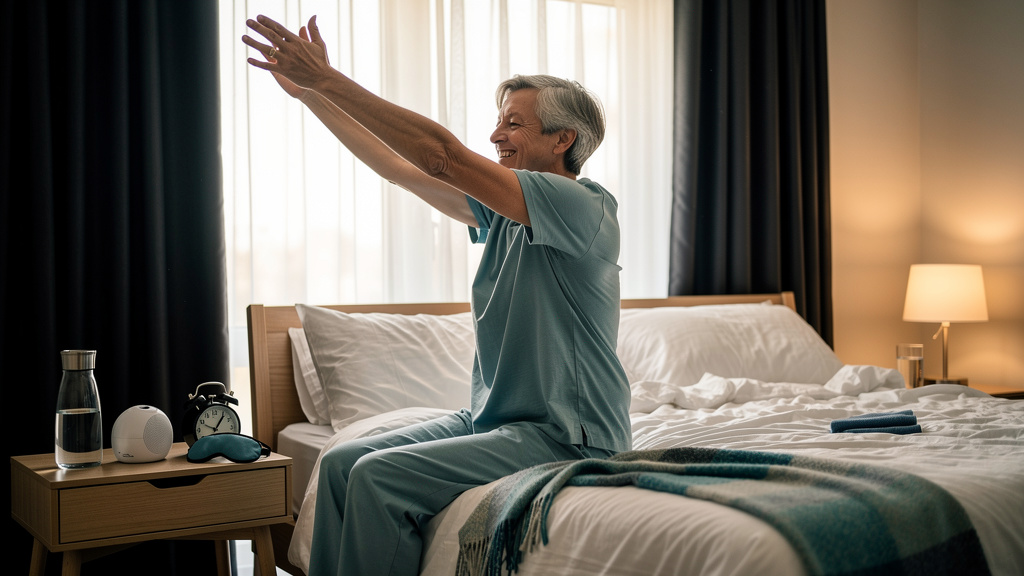
How to wake up refreshed: 10 sleep habits backed by CDC and AASM guidance
To wake up refreshed, give yourself at least 7 hours of sleep opportunity, keep the same wake time every day including weekends, and get bright light soon after you get up. Then remove the usual saboteurs: late caffeine, alcohol and heavy meals close to bed, and a bright, noisy or warm bedroom. If you still struggle most nights for months, cognitive behavioral therapy for insomnia (CBT-I) is the recommended first treatment, and loud snoring with daytime sleepiness should be evaluated for sleep apnea.
Most sleep lists hand you 17 tips at once. That is why most people try three, see no change in a week, and give up. The habits below are ranked in the order to try them, because the first few set your body clock and the rest only work well once that clock is stable. Give each new habit about two weeks before you judge it.
| Rank | Habit | Why it works |
|---|---|---|
| 1 | Protect at least 7 hours in bed for sleep | You cannot feel rested on a sleep debt |
| 2 | Fixed wake time, 7 days a week | Anchors your circadian rhythm |
| 3 | Bright light soon after waking | Light is the strongest signal to your body clock |
| 4 | Caffeine cut-off by early afternoon | Its stimulating effect lasts for hours |
| 5 | Limit alcohol in the evening | It fragments sleep in the second half of the night |
| 6 | Finish large meals well before bed | Digestion and reflux disrupt sleep onset |
| 7 | Dark, quiet, cool bedroom | Removes the signals that cause light, broken sleep |
| 8 | Devices out of bed | Screens keep your brain alert and delay sleep |
| 9 | A 30 to 60 minute wind-down | Gives your nervous system time to downshift |
| 10 | Get up if you can't sleep | Retrains your brain to link bed with sleep |
1. How much sleep you need, and how to find your own number
The CDC recommends at least 7 hours of sleep per night for adults, which matches the consensus statement from the American Academy of Sleep Medicine and the Sleep Research Society. Needs are higher in childhood and adolescence:
| Age group | Recommended sleep (CDC) |
|---|---|
| School age, 6 to 12 years | 9 to 12 hours per 24 hours |
| Teens, 13 to 18 years | 8 to 10 hours per 24 hours |
| Adults, 18 to 60 years | 7 or more hours per night |
| Adults, 61 to 64 years | 7 to 9 hours |
| Adults, 65 and older | 7 to 8 hours |
"At least 7" is a floor, not your personal number. To find yours, keep a simple sleep diary for two weeks: lights out, estimated time to fall asleep, wake ups, final wake time, and how you feel at 10 a.m. on a 1 to 5 scale. The amount of sleep that reliably gives you a 4 or 5 without an alarm fight is your target. A vacation week without alarms works too, once the first few catch-up nights are over.
Then do the math backward. If you need 7.5 hours and it takes you 15 minutes to fall asleep, you need about 7 hours 45 minutes in bed. Set a lights-out time that protects it. The NIH treats sleep as a core part of health, not a luxury, and the first habit is simply giving it enough room.
2 and 3. A fixed wake time every day, plus morning light
If you change only one thing, make it your wake time. Your body clock sets the timing of sleepiness, alertness, body temperature and hormones, and it calibrates mainly off when you wake and when you see light. Sleeping in two hours on Saturday and Sunday shifts that clock later, which is why Monday nights are often the hardest. The CDC advises going to bed and getting up at the same time each day, including weekends.
Pick a wake time you can keep seven days a week. Let bedtime follow sleepiness at first; a steady wake time tends to pull your bedtime into place within a couple of weeks.
Pair it with light. Get outside within the first hour of waking, even on a cloudy day, or sit by your brightest window. Morning light tells your clock that the day has started, which helps you feel sleepy at a consistent time that night. Keep naps short and early: Mayo Clinic suggests limiting naps to no more than an hour and avoiding them late in the day, because long or late naps borrow from the night.
4 to 6. Caffeine cut-off, alcohol and late meals
Caffeine. Caffeine blocks the chemical signal that builds sleep pressure through the day. Mayo Clinic notes that the stimulating effects of caffeine and nicotine take hours to wear off and can interfere with sleep. A practical rule: no caffeine after early afternoon, and count hidden sources like pre-workout drinks, energy drinks, dark chocolate and some teas. If you are sensitive, move the cut-off earlier.
Alcohol. A nightcap can feel like a sleep aid, but Mayo Clinic explains that alcohol may make you feel sleepy at first and then disrupts sleep later in the night. That is the classic 3 a.m. wake up followed by restless dozing. If you drink, keep it modest and earlier in the evening, and notice how your diary scores change on alcohol-free nights.
Late meals. The CDC lists avoiding large meals, caffeine and alcohol before bedtime among its healthy sleep habits. A heavy dinner close to bed can trigger reflux and keeps your body working when it should be winding down. Aim to finish your main meal a few hours before lights out; a light snack is fine if hunger keeps you up.
7 and 8. Your bedroom: dark, quiet, cool, and device rules
The CDC recommends a bedroom that is quiet, dark, relaxing and at a comfortable temperature, and Mayo Clinic describes the ideal sleep environment as cool, dark and quiet. Here is how to get there:
- Dark: blackout curtains or a comfortable eye mask. Cover or remove glowing chargers and LED lights.
- Quiet: earplugs or a steady white noise source if you live with traffic, a partner who snores, or early birds in the house.
- Cool: most people sleep better on the cooler side of comfortable. Lighter bedding and breathable sleepwear help, especially in a South Florida summer.
Device rules. The CDC suggests removing electronic devices such as TVs, computers and smartphones from the bedroom. Screens keep your brain engaged, and bright light late in the evening works against the signal your morning light sent. Charge your phone outside the bedroom or across the room, and buy a cheap alarm clock so the phone is not your excuse. If you check the time at night, turn the clock away; clock watching feeds the frustration that keeps you awake.
9 and 10. A 30 to 60 minute wind-down, and what to do when you can't fall asleep
Your brain does not switch from inbox to sleep in five minutes. Build a 30 to 60 minute routine that starts at the same time each night: dim the lights, finish screens, and do something calm and repeatable, such as a warm shower, light stretching, reading a paper book, or writing tomorrow's to-do list so it is out of your head. Mayo Clinic recommends managing worries before bed, and regular physical activity during the day, just not too close to bedtime.
The last habit is the one most people get wrong. If you are lying awake, stop trying to force it. Mayo Clinic advises that if you don't fall asleep within about 20 minutes, leave the bedroom and do something relaxing, then return when you feel tired. This is called stimulus control. Over a few weeks it breaks the link your brain has formed between your bed and being awake and frustrated. It feels counterintuitive and often makes the first nights harder, which is normal.
Chronic insomnia: CBT-I is the first-line treatment
If you have trouble falling or staying asleep most nights for months, despite good habits, you are likely dealing with chronic insomnia, and more tips will not fix it. The American College of Physicians 2016 clinical practice guideline recommends cognitive behavioral therapy for insomnia (CBT-I) as the initial treatment for chronic insomnia in adults, ahead of sleep medication.
CBT-I is a structured program, usually over several weeks, that typically includes:
- Stimulus control, the get-up rule above, applied consistently.
- Sleep restriction, temporarily matching time in bed to the sleep you actually get, then expanding it. This works best with clinician guidance because it causes short-term sleepiness.
- Cognitive work on the anxious thoughts about sleep that keep you alert.
- Sleep hygiene and relaxation training.
CBT-I is delivered by trained therapists, sleep clinics and some structured digital programs. Sleep hygiene alone is helpful, but it is only one piece of CBT-I.
When habits aren't enough: sleep apnea and restless legs
Some people sleep a full 8 hours and still wake up exhausted. That pattern points to a problem with sleep quality that no habit list can solve. Talk with a clinician if you notice:
| Possible sign | What it may point to |
|---|---|
| Loud, frequent snoring | Obstructive sleep apnea |
| A partner sees you stop breathing, gasp or choke | Obstructive sleep apnea |
| Morning headaches, dry mouth, dozing off while driving or reading | Sleep apnea or another sleep disorder |
| An urge to move your legs with uncomfortable sensations, worse in the evening and at rest, eased by moving | Restless legs syndrome |
| Insomnia that persists despite consistent habits | Chronic insomnia, mood, medication or hormonal factors |
Sleep apnea is diagnosed with a sleep study, often done at home, and it is treatable. Restless legs evaluation often includes blood work, since clinicians commonly check iron stores.
This is where a whole-body view helps. At BioCure Health, persistent fatigue is evaluated as part of a bigger picture. Our comprehensive Male and Female panels cover 90+ biomarkers, including hormones, thyroid, metabolic and organ markers, and every result is reviewed with a specialist. Our homepage lists Sleep Protocols within the Energy and Testosterone program: physician-guided plans built after your consultation and labs, tailored to your results rather than a one-size-fits-all formula. If you are also exploring peptide therapy, you can raise it in the same visit, though no protocol replaces the habits above or a sleep study when apnea is suspected.
Visits are physician-led and available by video or in person in Fort Lauderdale, and we are licensed to treat patients in 47 states, with availability in your state confirmed at intake. The physician consultation is $199 and can be credited toward a membership. We do not bill insurance directly, but many patients use HSA or FSA funds, and we provide documentation for reimbursement. You can reach the team through our contact page. For the long view on why this matters, read about the longevity benefits of quality sleep and how sleep impacts longevity and aging.
Frequently asked questions
How many hours of sleep do I actually need to feel rested?
The CDC recommends at least 7 hours per night for adults aged 18 to 60, with ranges of 7 to 9 hours for ages 61 to 64 and 7 to 8 hours for 65 and older. Your personal need may be higher. A two-week sleep diary tracking sleep length and how alert you feel mid-morning is the simplest way to find it.
Why do I wake up tired even after 8 hours of sleep?
Common causes include an irregular wake time, alcohol fragmenting the second half of the night, a warm or noisy bedroom, and late caffeine. If those are handled and you still wake unrefreshed, especially with loud snoring or witnessed pauses in breathing, ask a clinician about testing for sleep apnea.
What time should I stop drinking coffee for better sleep?
Mayo Clinic notes that caffeine's stimulating effects take hours to wear off. A practical rule is no caffeine after early afternoon, and earlier if you are sensitive. Remember that energy drinks, pre-workout supplements and some teas count too.
Is it bad to sleep in on weekends?
Sleeping in by a couple of hours shifts your body clock later, which often makes Sunday and Monday nights harder. The CDC advises keeping the same sleep and wake times every day, including weekends. If you are short on sleep, an earlier bedtime is a better fix than a later wake time.
What should I do if I can't fall asleep?
If you are still awake after about 20 minutes, Mayo Clinic advises leaving the bedroom and doing something relaxing until you feel sleepy, then returning to bed. Avoid screens and bright light while you are up. Over a few weeks, this retrains your brain to associate bed with sleep.
What is the best treatment for chronic insomnia?
The American College of Physicians 2016 guideline recommends cognitive behavioral therapy for insomnia (CBT-I) as the initial treatment for chronic insomnia in adults. It combines stimulus control, sleep restriction, cognitive techniques and sleep hygiene over several weeks. Medication is generally considered only if CBT-I alone is not enough.
Waking up refreshed is not luck. It is the result of a steady clock, a protected sleep window, and a bedroom built for one job, plus the willingness to get checked when habits are not enough. Start with habit one, add the next every two weeks, and let your diary tell you what is working.
Let BioCure Health lead you in the right direction. Call or text us to schedule an introductory call at 754-206-0838, your future self will thank you.