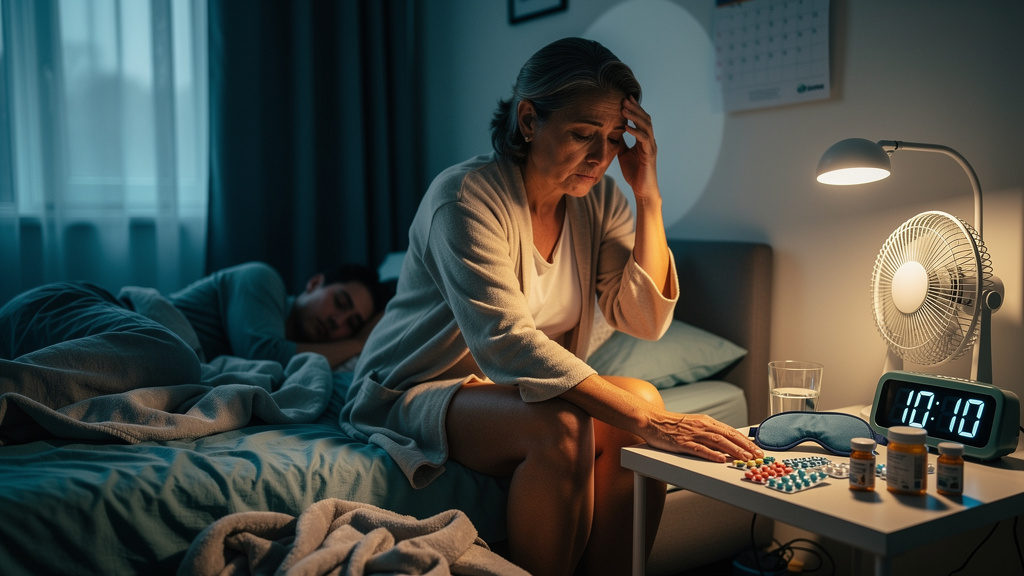
How testosterone, menopause and thyroid affect your sleep quality
Yes. Low testosterone, perimenopause and menopause, and an overactive or underactive thyroid can all disrupt sleep, and poor sleep can push hormones further off balance. Treating a confirmed hormone problem can help, most clearly when menopausal night sweats are what wake you, but hormone therapy is not a sleep cure, and the basics (7 or more hours, a consistent schedule, and screening for sleep apnea) still come first.
Most sleep advice stops at sleep hygiene. That advice matters: according to NIH News in Health, adults need 7 or more hours a night, and going to bed and waking at the same times, limiting caffeine and alcohol, and keeping your bedroom dark and cool all support better rest. But if you do all of that and still wake at 3 a.m. drenched in sweat, or sleep eight hours and wake exhausted, your hormones deserve a look. This review covers what the evidence actually supports, and where it runs thin.
Low testosterone and sleep: the link runs both ways
Testosterone in men follows a daily rhythm. It is highest in the morning, and its release is closely tied to sleep. That is why the Endocrine Society's 2018 clinical practice guideline on testosterone therapy recommends diagnosing low testosterone only when a man has symptoms and consistently low levels, confirmed on repeat morning fasting blood tests. A single afternoon reading after a bad week of sleep can mislead you and your doctor.
The relationship works in both directions:
- Low testosterone can affect how you feel at night and during the day. Men with low levels often report fatigue, low energy and poor sleep. Those symptoms are nonspecific, though, and overlap with depression, thyroid disease and sleep apnea.
- Poor sleep can lower testosterone. Research on sleep restriction has linked short, fragmented sleep with lower testosterone, and untreated obstructive sleep apnea is associated with lower levels as well.
The practical takeaway: if you are sleeping five or six hours a night, fix that first and retest. Some men who look borderline on paper are really short on sleep. If levels stay low on repeat morning testing and you have symptoms, that is when therapy becomes a real conversation. You can read more on how BioCure evaluates this on our testosterone therapy page.
Testosterone therapy and sleep apnea: screen before you start
This is the part of the hormone and sleep story that matters most for safety. The Endocrine Society's 2018 guideline recommends against starting testosterone therapy in men with untreated severe obstructive sleep apnea. Testosterone therapy can worsen apnea in some men, and the guideline also calls for monitoring blood counts during treatment, because testosterone can raise red blood cell levels.
Signs that you should be evaluated for sleep apnea include:
- Loud, regular snoring
- A partner noticing pauses in your breathing, gasping or choking
- Morning headaches or a dry mouth on waking
- Heavy daytime sleepiness despite enough time in bed
If your history points to apnea, the right next step is a sleep study, either in a lab or at home, and treatment if it confirms apnea. That can happen before testosterone therapy or alongside it once the apnea is controlled. Treating apnea often improves energy on its own, and it makes any later testosterone decision cleaner.
At BioCure, men's hormone care comes in three tiers: bioOptimize (foundational), bioRestore (medications that raise your own testosterone without direct hormone replacement) and bioTest (full testosterone replacement with ongoing hormone monitoring). Which one fits depends on your labs, your symptoms and your sleep history, not on a preset plan.
Perimenopause and menopause: night sweats, insomnia and hormone therapy
Sleep often falls apart during the menopause transition. Hot flashes and night sweats wake women repeatedly, insomnia becomes more common, and mood changes and anxiety can make it harder to fall back asleep. The risk of sleep apnea also rises after menopause, which is easy to miss when everything gets blamed on hot flashes.
The Menopause Society's 2022 hormone therapy position statement is the clearest guidance here. Its key points, in plain English:
- Hormone therapy is the most effective treatment for hot flashes and night sweats.
- For healthy women under 60, or within 10 years of menopause onset, without contraindications, the benefits of hormone therapy for bothersome symptoms generally outweigh the risks.
- Women who still have a uterus and take estrogen need a progestogen to protect the uterine lining.
- Sleep tends to improve most when night sweats are what is disrupting it.
That last point is the honest caveat. Hormone therapy is not prescribed for insomnia by itself. If you are waking because of night sweats, treating them can give you your nights back. If your insomnia is driven by anxiety, racing thoughts or habits, cognitive behavioral therapy for insomnia (CBT-I) is the standard first treatment, and hormones alone may not fix it. BioCure offers hormone optimization for women, including progesterone cream and estradiol patches, prescribed after an evaluation and labs.
Thyroid: too much keeps you up, too little drags you down
Your thyroid sets your metabolic pace, and sleep follows it.
- Hyperthyroidism (overactive thyroid) can cause trouble falling and staying asleep, along with a racing heart, anxiety, tremor, heat intolerance and sweating at night. It can look a lot like perimenopause or an anxiety disorder.
- Hypothyroidism (underactive thyroid) tends to cause fatigue, daytime sleepiness and waking unrefreshed. It can also contribute to sleep apnea.
The good news is that thyroid problems are straightforward to check with a blood test, typically TSH plus free T4, and treating the underlying thyroid problem is the main fix for thyroid related sleep symptoms. One caution: taking thyroid hormone you do not need, or too high a dose, can itself cause insomnia and palpitations. Thyroid treatment should be based on labs, not on feeling tired.
Cortisol and stress: what is real and what is wellness marketing
Cortisol is the hormone most often blamed for bad sleep online, so it helps to separate fact from sales copy.
| Claim | What is real | What is marketing |
|---|---|---|
| Cortisol has a daily rhythm | Real. It peaks shortly after waking and falls to its lowest point around the middle of the night. | Claims that one supplement can "reset" this rhythm. |
| Stress hurts sleep | Real. Chronic stress, shift work and irregular schedules disrupt cortisol and sleep together. | The idea that stress is purely a hormone problem to be fixed with a pill. |
| Adrenal disease exists | Real. Cushing's syndrome and adrenal insufficiency are diagnosable medical conditions. | "Adrenal fatigue" is not a recognized medical diagnosis. |
| Cortisol testing | Can be one data point, read by a clinician alongside symptoms. | A single test used to sell an "adrenal reset" protocol. |
What actually moves the needle on stress related sleep is unglamorous: a fixed wake time, morning daylight, cutting off caffeine well before bed, and limiting alcohol, which the NIH notes can disrupt sleep later in the night. BioCure does offer an adrenal and stress test, and every result is interpreted with a specialist, but it is a tool for understanding your pattern, not a shortcut to a diagnosis.
Sermorelin and growth hormone peptides: the claims vs the evidence
Growth hormone is released mostly during deep sleep, which is why growth hormone peptides get marketed for sleep. Sermorelin is a synthetic version of the signal your brain uses to tell the pituitary gland to release its own growth hormone. BioCure's peptide therapy page lists sermorelin as commonly used for sleep quality, recovery, and body composition.
Here is the honest picture. The human evidence that sermorelin improves sleep quality in adults is limited: there are no large, long randomized trials showing it does. Some patients report deeper sleep, but reports are not proof, and sleep is notoriously sensitive to expectation. There is no FDA approved sermorelin product marketed for adult sleep or anti-aging use; it is typically prepared by licensed compounding pharmacies.
If you are curious, sermorelin is a reasonable thing to discuss as a physician guided option after an evaluation and labs, with clear goals and follow-up, not as a promise of better nights. It should not replace treating sleep apnea, menopause symptoms or a thyroid problem. For a deeper comparison, see our post on sermorelin vs ipamorelin after 40.
Putting it together: what to check and when
| Hormone issue | Typical sleep pattern | First step | What treatment evidence shows |
|---|---|---|---|
| Low testosterone (men) | Fatigue, poor sleep, low energy | Repeat morning fasting testosterone; screen for apnea | Endocrine Society: confirm diagnosis first; avoid starting therapy with untreated severe apnea |
| Perimenopause and menopause | Night sweats, frequent waking, insomnia | Symptom history, labs, apnea screen if snoring | Menopause Society: hormone therapy most effective for night sweats; sleep improves most when sweats drive waking |
| Hyperthyroidism | Trouble falling and staying asleep, racing heart | TSH and free T4 | Treating the thyroid is the main fix |
| Hypothyroidism | Daytime sleepiness, unrefreshing sleep | TSH and free T4 | Treating the thyroid is the main fix |
| Cortisol and stress | Wired at night, tired in the morning | Schedule, light, caffeine and alcohol review | Habits first; "adrenal fatigue" is not a diagnosis |
| Growth hormone (sermorelin) | Shallow or unrefreshing sleep | Evaluation and labs | Limited human evidence for sleep |
A decade ago, most people only did blood work when something felt wrong. Now you can see your hormones, thyroid and metabolic markers before guessing. BioCure's comprehensive Male and Female panels, described on our diagnostics page as covering 90+ biomarkers, include hormones, thyroid, lipids, metabolic and organ markers. You can test with an at-home kit and an in-home phlebotomist visit or in a lab, with results in 7 to 14 days, followed by a one-on-one review with a specialist. The physician video consultation is $199, which can be credited back with a membership. BioCure is licensed in 47 states, with availability confirmed at intake, and while it does not accept insurance directly, many patients use HSA or FSA funds with the invoices BioCure provides. For the bigger picture on why rest drives everything else, read Fix your sleep, fix your hormones.
Frequently asked questions
Can low testosterone cause insomnia?
Low testosterone is linked with fatigue and poor sleep, but those symptoms are nonspecific and also fit sleep apnea, depression and thyroid disease. The link also runs the other way, since short or disrupted sleep is associated with lower testosterone. The Endocrine Society recommends confirming low levels with repeat morning fasting tests before treating.
Does testosterone therapy make sleep apnea worse?
It can in some men. The Endocrine Society's 2018 guideline recommends against starting testosterone therapy in men with untreated severe obstructive sleep apnea. If you snore loudly or a partner notices pauses in your breathing, get a sleep study first.
Will hormone therapy help me sleep during menopause?
It often helps when night sweats are what wake you, because The Menopause Society's 2022 position statement names hormone therapy the most effective treatment for hot flashes and night sweats. It is not prescribed for insomnia alone. If anxiety or habits drive your insomnia, CBT-I is the standard first treatment.
Can thyroid problems affect sleep?
Yes. An overactive thyroid can cause insomnia, a racing heart and night sweating, while an underactive thyroid tends to cause daytime sleepiness and unrefreshing sleep. A simple blood test checks both, and treating the thyroid problem is the main fix.
Does sermorelin really improve sleep?
The human evidence is limited, with no large trials showing it improves sleep quality in adults. BioCure lists it as commonly used for sleep quality, recovery and body composition, and offers it as a physician guided option after labs, not as a guaranteed result.
How do I know if my bad sleep is hormonal?
Start with the basics: 7 or more hours, a consistent schedule, and limited caffeine and alcohol. If sleep is still poor, or you have night sweats, snoring, a racing heart or daytime exhaustion, a lab panel and a clinician review can show whether hormones, thyroid or sleep apnea are involved.
Longevity is not accidental, it is intentional. Good sleep is built the same way: solid habits, apnea ruled out, and hormones checked with real data instead of guesses.
Let BioCure Health lead you in the right direction. Call or text us to schedule an introductory call at 754-206-0838. Your future self will thank you.