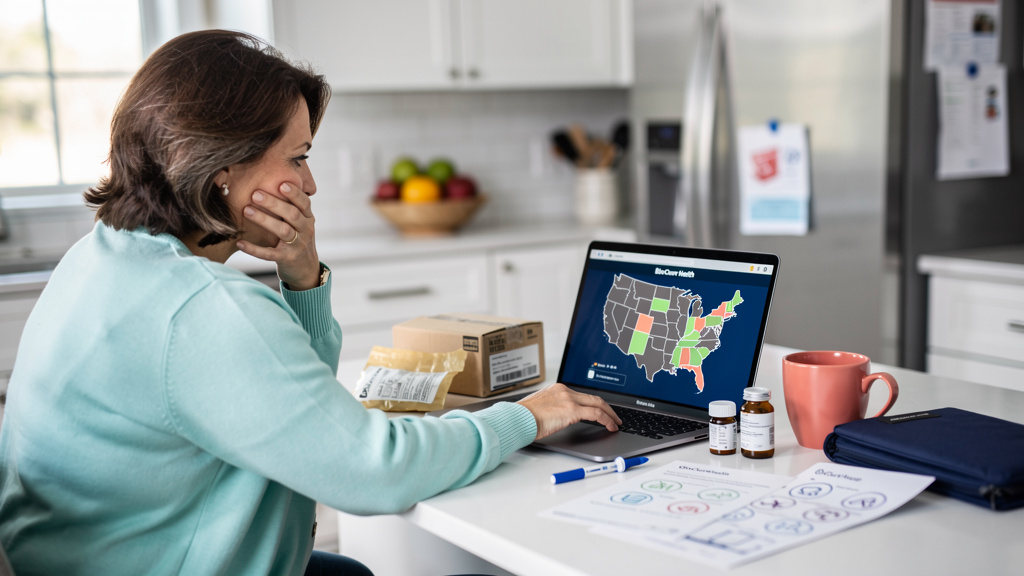
Why some GLP-1 programs can't ship to your state
A "nationwide" GLP-1 program can only treat you if its prescribing clinician is licensed in the state where you are located and its pharmacy is allowed to ship medication into that state. Each state sets those rules through its own medical and pharmacy boards, and compounding policies, telehealth prescribing standards and insurance coverage add more layers on top. That is why most programs that advertise nationwide GLP-1 therapy actually cover many states, not all 50, and why a gap in your state usually reflects licensing, not anything about you.
State access maps can show you where a program operates. They rarely explain why the holes exist. Here is what sits behind them, and what you can do if your state is one of the gaps.
Your prescriber has to be licensed where you are
Semaglutide and tirzepatide are prescription medications, so a licensed clinician has to evaluate you and write the prescription. In the United States, medical licenses are issued state by state. The general rule for telehealth is that the clinician must be licensed in the state where you are physically located at the time of the visit, not the state where the clinic is based.
For a telehealth weight loss clinic, every new state means new licenses for its prescribers, with separate fees, renewals and requirements for each board. Interstate licensure compacts for physicians and nurses have made multistate licensing faster, but they do not include every state or every type of clinician. A clinic with a small medical team may simply not have a prescriber licensed in your state yet.
This is also why a trustworthy program asks for your state before anything else. BioCure Health is licensed to treat patients in 47 states, and we confirm availability for your state during the online intake, which takes about five minutes.
The pharmacy needs permission to ship into your state
Even with a licensed prescriber, the medication has to come from somewhere. Most states require a pharmacy located elsewhere to hold a nonresident pharmacy license or registration before it can mail prescriptions to residents. Each state has its own application, standards and oversight, and states generally expect the pharmacy to be in good standing in its home state as well.
So a program can have a licensed doctor in your state and still be unable to serve you because its partner pharmacy is not licensed there. Many programs rely on one or two pharmacies. Their real state list is the overlap between where their prescribers are licensed and where their pharmacies are licensed.
Injectable medications tighten this further. Injectables must be prepared under sterile conditions, and states differ in how they license and inspect sterile compounding done out of state. Fewer pharmacies qualify everywhere, so the map shrinks.
Compounding rules narrowed after the shortages ended
During the GLP-1 shortages, federal law allowed compounding pharmacies to make versions of semaglutide and tirzepatide that were essentially copies of the approved drugs. That flexibility depends on a drug being in shortage. Once the FDA determined the shortages had been resolved, it clarified its policies for compounders: after a transition period, compounders were expected to stop making copies of the approved products.
Two federal categories matter here. Traditional compounding pharmacies, often called 503A pharmacies, prepare medications for individual patients based on a prescription and are overseen mainly by state boards of pharmacy. Outsourcing facilities, called 503B facilities, register with the FDA and can produce larger batches. Neither produces FDA approved drugs. Compounded medications are not reviewed by the FDA for safety, effectiveness or quality before they reach you.
On top of the federal rules, each state board of pharmacy can issue its own guidance, inspect pharmacies and take action against those it believes are out of compliance. Policies on compounded GLP-1s have shifted at different times in different places, so a pharmacy can be able to dispense in one state and not in another. Programs that built their business around low cost compounded semaglutide were the most exposed to these changes.
If you are comparing nationwide weight loss clinics offering GLP-1 therapy, ask directly whether the medication is a brand product or a compounded one, which pharmacy fills it, and whether that pharmacy is licensed in your state.
Telehealth prescribing standards vary by state
The federal law that requires an in-person exam before controlled substances are prescribed online does not apply to semaglutide or tirzepatide, because they are not controlled substances. That is part of why GLP-1 therapy moved to telehealth so quickly.
States still set their own standards for how a clinician establishes a patient relationship remotely. A live video visit is widely accepted as a valid way to do that. Rules for asynchronous care, where you fill out a questionnaire and a clinician reviews it later without speaking to you, are less uniform, and some states restrict prescribing based on a questionnaire alone. A program built around questionnaire approvals may skip stricter states rather than change its model.
Our article on how telehealth is shaping the future of medicine covers where remote care works best. At BioCure, every patient has a consultation with a physician, by video or in person at our Fort Lauderdale area clinic, before any medication is prescribed. Our semaglutide and tirzepatide protocols also require a blood panel first, because a weight loss plan should be built on your actual numbers.
Insurance and Medicaid coverage add another layer
Coverage creates a different kind of state gap. Medicaid is run by each state within federal rules, and the HHS summary of state Medicaid telehealth coverage shows that telehealth policies differ from one state program to the next. Whether a state's Medicaid program covers GLP-1 medications for weight management is a separate decision, and that answer also differs by state. State employee health plans make their own choices, and some have added or pulled back coverage for anti-obesity medications as costs have risen. Medicare drug plans have historically excluded medications used only for weight loss.
In practice, two people with similar health profiles can have very different coverage depending on where they live. A program that bills insurance may only operate where it has payer contracts. Cash-pay programs avoid that limit but leave the cost with you.
BioCure does not accept health insurance directly. Many patients pay with HSA or FSA funds, and we provide invoices and documentation for reimbursement. The physician video consultation is $199 and can be credited back with a membership. Membership pricing depends on your protocol and is set at your consultation.
How to check whether a nationwide program can treat you
Here is the full picture in one place.
| Barrier | Who sets the rule | What it can mean for you |
|---|---|---|
| Prescriber licensing | State medical and nursing boards | No licensed clinician in your state, so no visit |
| Pharmacy licensing | State boards of pharmacy | The pharmacy cannot legally ship to your address |
| Compounding limits | FDA and state boards of pharmacy | Compounded versions may be restricted or unavailable |
| Telehealth standards | State law and medical boards | Questionnaire only programs may avoid your state |
| Coverage | State Medicaid programs, state employee plans, private insurers | Insurance-billed programs may not operate where you live |
Before you hand over a card number, ask these questions:
| Question to ask | Why it matters |
|---|---|
| Which states are you licensed in, and is mine included? | "Nationwide" is a marketing word, not a legal status |
| Who prescribes, and are they licensed in my state? | The prescriber's license must match your location |
| Which pharmacy fills my prescription, and is it licensed to ship here? | The pharmacy is often the real bottleneck |
| Is the medication brand or compounded? | Compounded drugs are not FDA approved and face tighter rules |
| Will I speak with a clinician live? | Some states limit questionnaire only prescribing |
| Do you require labs before starting? | Baseline labs help your clinician dose and monitor safely |
| Do you bill insurance or is it cash pay? | Coverage rules vary by state and plan |
What to do if your state is not served
A gap in one program's map does not mean you are out of options.
- Check another licensed telehealth program. Use the questions above, and confirm the state list on the program's official website rather than a third party directory, since directories can lag behind licensing changes.
- Look at brand self-pay channels. Eli Lilly and Novo Nordisk now sell some branded GLP-1 medications directly to self-pay patients through their own programs, LillyDirect and NovoCare Pharmacy. You still need a prescription from a clinician licensed in your state.
- See a local obesity medicine physician. Physicians certified by the American Board of Obesity Medicine focus on weight management and may bill your insurance.
- Try an academic medical center. University hospital weight management programs often offer team-based care, including nutrition, behavioral support and surgical evaluation, and some run clinical trials.
- Start with your primary care physician. They know your history and can prescribe, order labs or refer you.
If you are not sure whether BioCure serves your state, contact our team. We reply to new inquiries within 24 hours.
Frequently asked questions
Why does a nationwide weight loss clinic say it can't treat me in my state?
Usually the clinic either has no prescriber licensed in your state or its partner pharmacy is not licensed to ship there. State compounding rules, telehealth standards and insurance contracts can also limit where a program operates. It is a regulatory gap, not a judgment about your eligibility.
Can I use a GLP-1 telehealth program based in another state?
Yes, as long as the clinician is licensed in the state where you are physically located during the visit and the pharmacy is licensed to ship to your address. Where the clinic is headquartered does not matter. A legitimate program will not help you list a different location to work around these rules.
Is compounded semaglutide still allowed in 2026?
Compounding itself remains legal under federal law, but the rules narrowed once the FDA declared the semaglutide and tirzepatide shortages resolved. The FDA clarified that compounders were expected to stop making copies of the approved drugs after a transition period. Compounded medications are not FDA approved, so ask your clinician exactly what you are being prescribed and why.
Does Medicaid cover Wegovy or Zepbound for weight loss?
It depends on your state. Each state Medicaid program decides whether to cover GLP-1 medications for weight management, and policies have changed over time as costs have risen. Check with your state Medicaid program or plan directly.
Do GLP-1 telehealth programs require an in-person visit?
Usually not, because semaglutide and tirzepatide are not controlled substances, so the federal in-person exam requirement for online controlled substance prescribing does not apply. States set their own standards for establishing a patient relationship remotely, and a live video visit is widely accepted. Many programs also require lab work before you start.
Which states does BioCure Health serve for GLP-1 weight loss?
BioCure Health is licensed to treat patients in 47 states. We confirm availability for your state during the five minute online intake, or you can call or text 754-206-0838 to ask. Appointments can be done by video or in person at our clinic in the Fort Lauderdale area.
State lines shape GLP-1 access more than most marketing admits. When you know which rule is behind a gap, you can ask sharper questions, choose a program that is genuinely licensed to treat you, and start a plan built on real data rather than a sales page. Longevity is not accidental, it is intentional, and that starts with care that is set up properly where you live.
Let BioCure Health lead you in the right direction. Call or text us to schedule an introductory call at 754-206-0838. Your future self will thank you.