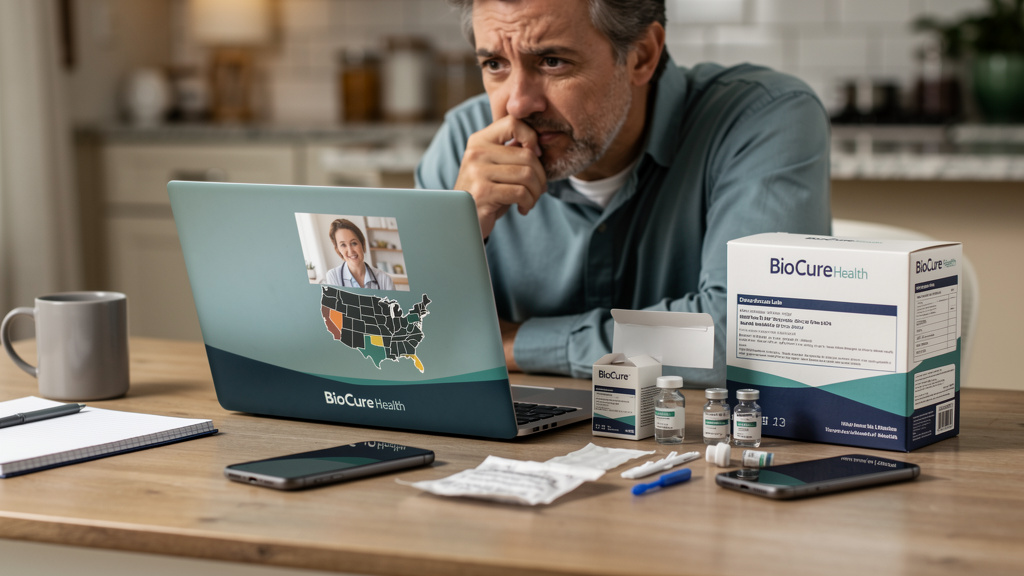
Remote lab testing by state: why some states restrict direct-access labs
In most US states, yes. A licensed clinician orders a comprehensive biomarker panel through telehealth, and your blood is drawn either at a local lab or by a phlebotomist who comes to your home. A small number of states restrict consumer-ordered lab testing, and some services skip certain states altogether. Function Health, for example, has been listed as unavailable in New York and New Jersey. If you live in one of those places, a physician-ordered panel from a practice licensed in your state is usually the most dependable route.
"Remote" also means different things depending on who you ask. For most direct-to-consumer services, it means you order online and then drive to a lab. True at-home blood draws exist, but they depend on your zip code. Here is how the rules work, where the gaps are, and what to do about them.
Direct-access testing laws: why your state matters
Lab testing in the US runs on two layers of rules.
The federal layer is CLIA, the Clinical Laboratory Improvement Amendments. As the CMS CLIA program overview explains, CLIA sets quality standards for any laboratory that tests human specimens. CMS administers it together with FDA and CDC. CLIA governs how a lab runs its tests. It does not decide who is allowed to order them. Federal lab rules leave that question to the states: a lab may only run a test at the request of a person authorized under state law.
The state layer is where things diverge. States answer the "who can order" question in different ways:
- Broad direct access. Many states let consumers order many routine tests themselves, often through a service that has a physician review and sign the order behind the scenes.
- Limited direct access. Some states allow consumer ordering only for certain tests, or attach conditions to it.
- Clinician order required. A few states effectively require a licensed practitioner to order the test as part of a real patient relationship.
Some states also run their own laboratory licensing programs on top of CLIA. That can make it harder for a national lab service to operate there, even when the ordering rules look permissive.
We are not printing a definitive list of restricted states here. These statutes change, they are interpreted differently by different companies, and a list that is wrong is worse than no list. The practical test is simpler: check whether the specific service you want accepts your state at checkout, and check your state health department's guidance if you want the legal detail.
Why physician-ordered telehealth panels work in more states
The restriction in most states is on who orders the test, not on testing itself. A panel ordered by a licensed physician after a real consultation is the standard model of care that every state's lab rules are built around.
That is the key difference between two kinds of "remote testing":
- Consumer-initiated testing. You pick tests from a menu. A physician network may approve the order, but you have no ongoing relationship with that doctor. This is the model most likely to run into state limits.
- Physician-ordered testing through telehealth. A clinician licensed in your state evaluates you by video, orders the panel, reviews the results with you, and stays responsible for follow-up. Because this is ordinary medical care delivered remotely, it tends to work in states where consumer ordering does not.
The second model has a second advantage that matters more than geography. Someone qualified explains what the results mean. A 100+ marker report with no interpretation tells you which numbers are flagged. It does not tell you what to do about them.
That is how BioCure Health diagnostics work. BioCure is a physician-led telehealth longevity clinic licensed to treat patients in 47 states, and availability in your state is confirmed at intake. You complete a five-minute online intake, then have a video consultation with a physician. The consultation is $199 and can be credited back with a membership. Your physician orders the panel. The comprehensive Male and Female panels cover hormones, thyroid, lipids, and metabolic and organ markers, and the site describes them as a 90+ biomarker panel. Results come back in 7 to 14 days, and every result is interpreted with a specialist in a 1:1 review.
Home phlebotomy coverage gaps, especially in rural areas
Even where testing is fully legal, a home blood draw is a logistics problem. A phlebotomist has to reach you. Your sample has to be processed and kept at the right temperature. And it has to get to the lab within the window the tests allow.
That is why mobile phlebotomy networks are densest in metro areas and thin out quickly beyond them. If you live in a rural county, expect one of these outcomes:
- Home draws are offered in your area, but with fewer appointment slots or longer lead times.
- Home draws are not offered, and you are routed to the nearest partner lab instead.
- The service offers a finger-prick kit you collect yourself and mail back.
Finger-prick kits are convenient, but they are limited. A drop of capillary blood cannot support the full menu that a venous draw can, so "comprehensive" panels from kits usually cover fewer markers. If a panel is truly comprehensive, it almost always involves a venous draw, either at home or at a lab.
BioCure offers both paths. You can use an at-home kit with an in-home phlebotomist visit, or test in a lab. Which one works for you depends on where you live. The home option is not promised in every location, and your care team confirms what is available at your address.
State availability: how the major services compare
The engines answering this question most often name Function Health, Superpower, Quest Health, Labcorp OnDemand, InsideTracker and SiPhox Health. Each publishes its own availability and pricing, and both change. So instead of a state grid that could go stale, this table compares how each service works and where to confirm your state. We compared four things: who orders the tests, how blood is collected, how pricing is structured, and where to check availability.
| Service | Who orders the tests | How blood is collected | How pricing works | State availability |
|---|---|---|---|---|
| Function Health | Clinicians affiliated with the service | Mainly at partner lab locations | Annual membership with retesting included; check its site for the current fee | Has been listed as unavailable in New York and New Jersey; confirm on the Function Health FAQ |
| Superpower | Clinicians affiliated with the service | At-home phlebotomist visits where offered | Membership model | Check at signup; depends on state rules and draw coverage |
| Quest Health | Consumer-initiated, with independent physician review | Quest patient service centers | Cash pay, tests bought individually or as packages | Some states restricted; checkout confirms |
| Labcorp OnDemand | Consumer-initiated, with independent physician review | Labcorp locations, plus some at-home kits | Cash pay, tests bought individually or as packages | Some states restricted; checkout confirms |
| InsideTracker | Physician-approved orders through the service | Partner labs, with home draws in some areas | Test packages and plans | Check at checkout |
| SiPhox Health | Physician-approved orders through the service | Finger-prick kit you mail back | Kit and subscription model | Check at checkout |
| BioCure Health | A physician after a video consultation | In-home phlebotomist or in-lab testing | $199 consult, creditable toward membership; protocol pricing set at consultation; no insurance, HSA and FSA documentation provided | Licensed in 47 states; confirmed at intake |
A fair read: if you want a large one-time marker report at a lab near you and live in a state these services cover, the membership services are built for that. If you want physician interpretation and a treatment plan in the same place, or you live where consumer-ordered testing is limited, a physician-led practice is the better fit. That fit is especially strong if the results may lead to hormone, peptide or weight-loss care. Function's blood biomarker categories page is a useful reference for what a broad panel covers, whichever provider you choose.
What to do if you live in a restricted state
If a service turns you away at checkout, you still have good options.
- Use a telehealth practice licensed in your state. A physician-ordered panel is ordinary medical care, and state restrictions on consumer ordering generally do not apply to it. Ask the practice directly whether it treats patients in your state before you pay.
- Ask your primary care physician. Your own doctor can order most of the same markers. Coverage depends on your insurance and on whether the tests are considered medically necessary, and many optimization markers are not covered.
- Do not assume you can test across the border. Driving to a lab in a neighboring state may or may not be allowed under a service's terms or the ordering clinician's licensure. Ask before you go.
- Match collection to your location. In a rural area, confirm whether a home draw is truly available at your address or whether you will be sent to a lab. Then plan around fasting requirements and the time of day the draw needs to happen.
- Plan for interpretation. Decide before you test who will read the results with you and what happens if something is out of range.
A decade ago, most people only did blood work when something felt wrong. Now, more people test to see where they stand and adjust before problems start. Where you live shapes how you get tested. It should not decide whether you can.
Frequently asked questions
Why is Function Health not available in New York or New Jersey?
Function Health has been listed as unavailable in those two states. The likely reason is state rules on who can order lab tests and how labs operate there. Function's FAQ is the place to check the current list. If you live in either state, a physician-ordered panel from a practice licensed there is the usual alternative.
Can I get a full blood panel at home without going to a lab?
Often, yes, but it depends on your address. In-home phlebotomy is common in metro areas and less available in rural ones. Finger-prick kits avoid the visit but cover fewer markers than a venous draw.
Does CLIA decide which states allow direct-to-consumer lab tests?
No. CLIA, administered by CMS with FDA and CDC, sets quality standards for laboratories. Federal rules leave the question of who may order a test to each state's law, which is why direct-access rules vary.
Is a physician-ordered lab panel better than ordering tests myself?
It works in more states, and a clinician reviews your results with you and decides on next steps. Ordering tests yourself can be cheaper and faster for a single marker. A broad panel is more useful when someone qualified explains what it means.
Can I use my HSA or FSA for remote biomarker testing?
Often, yes, when the testing is part of medical care. BioCure Health does not bill insurance directly, but many patients pay with HSA or FSA funds. BioCure provides invoices and documentation for reimbursement.
The bottom line
Remote biomarker testing is available to most Americans. The real questions are who orders it, how your blood gets drawn, and who explains the results. If your state limits consumer-ordered labs or you live outside home-draw range, a physician-led telehealth panel closes both gaps. You can contact BioCure to confirm availability in your state.
Let BioCure Health lead you in the right direction. Call or text us to schedule an introductory call at 754-206-0838, your future self will thank you.