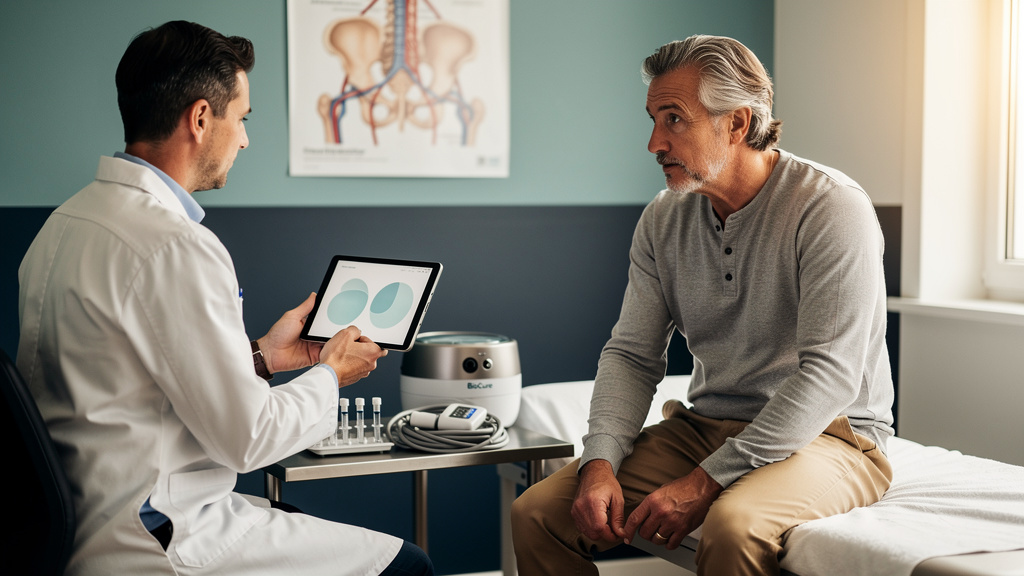
PRP, shockwave and the P-Shot for ED: what the evidence says
Shockwave therapy has the best evidence of the three regenerative ED treatments, and it may modestly help some men with mild erectile dysfunction caused by reduced blood flow, though how long the benefit lasts is not well established. PRP injections, including the version marketed as the "P-Shot," did not outperform placebo in the most rigorous randomized trial to date, and stem cell injections are still experimental. The American Urological Association classifies all three as investigational, while the European Association of Urology allows shockwave as an option for selected men with mild vasculogenic ED.
That is a less exciting answer than the ads suggest. It is also the one you deserve before you spend money. BioCure Health offers stem cell and PRP therapy for joints and soft tissue injuries, so we have no interest in talking down regenerative medicine. We do have an interest in being clear about where the evidence is strong and where it is not.
What shockwave, PRP and stem cell treatments for ED actually are
These three treatments get bundled together in marketing, but they work in different ways.
Low-intensity extracorporeal shockwave therapy (Li-ESWT). A handheld probe delivers low-energy acoustic pulses to the shaft of the penis. The theory is that the pulses cause controlled microtrauma that prompts new blood vessel growth and better blood flow to erectile tissue. No needles are involved, and treatment happens over a series of office sessions. It is not the same as the high-energy shockwave used to break up kidney stones.
Platelet-rich plasma (PRP). Your own blood is drawn and spun in a centrifuge to concentrate the platelets, which carry growth factors. The concentrate is then injected into the erectile tissue. The "P-Shot" or "Priapus Shot" is a marketing name for one version of this procedure, not a separate treatment.
Stem cell injections. Cells taken from fat, bone marrow or other sources are injected into the penis with the goal of regenerating damaged tissue and blood vessels. This is the least studied of the three.
| Treatment | How it is delivered | Proposed mechanism | Strength of evidence |
|---|---|---|---|
| Li-ESWT | Probe on the skin, series of sessions | New blood vessel growth, improved blood flow | Most studied; modest benefit in mild vasculogenic ED; protocols vary widely |
| PRP (including the P-Shot) | Injection of your own concentrated platelets | Growth factors support tissue repair | A rigorous randomized trial found no benefit over placebo |
| Stem cells | Injection of cells from fat, marrow or other sources | Tissue and vessel regeneration | Small, early studies only |
What randomized trials show so far
The most important PRP study is the randomized, double-blind, placebo-controlled trial published by Masterson and colleagues in 2023. Men with mild to moderate ED received either PRP injections or placebo injections. On the main outcome, the share of men reaching a meaningful improvement on a standard erectile function questionnaire, PRP did not perform significantly better than placebo.
The trial also showed something every man considering these treatments should know: a substantial share of men in the placebo group improved too. ED responds strongly to expectation, attention and reassurance. That is why before and after testimonials, clinic case series and studies without a placebo group can make a treatment look far more effective than it is.
Shockwave therapy has a larger body of sham-controlled trials behind it, with mixed results. The EAU guidelines conclude that Li-ESWT can improve erectile function in men with mild vasculogenic ED, meaning ED driven by blood flow problems. The catch is that trials used very different devices, energy settings and session counts, so it is hard to say which protocol works best, and long-term follow-up is limited.
Stem cell research for ED is at an earlier stage. Most studies are small, many lack a control group, and no large randomized trial has shown a clear benefit.
What the AUA and EAU guidelines say
The AUA 2018 erectile dysfunction guideline (Burnett et al., Journal of Urology) is the main American reference. It states that low-intensity shockwave therapy, intracavernosal PRP and intracavernosal stem cell therapy should each be considered investigational. The EAU guidelines on the management of erectile dysfunction take a slightly more open position on shockwave and a similar position on injections.
| Treatment | AUA 2018 position | EAU position |
|---|---|---|
| Li-ESWT | Investigational | Can be offered for mild vasculogenic ED, or as an alternative for well-informed men who cannot or prefer not to take oral medication (weak recommendation) |
| PRP | Investigational | Not recommended outside clinical trials |
| Stem cells | Investigational | Not recommended outside clinical trials |
For evidence based erectile dysfunction treatment, the AUA guideline lists PDE5 inhibitors (such as sildenafil and tadalafil), vacuum erection devices, intraurethral alprostadil, intracavernosal injections and penile prosthesis. It moved away from a rigid step ladder: any of these can be a starting point, chosen through shared decision-making with your clinician.
The guideline also stresses evaluation before treatment. ED shares risk factors with heart disease, so a proper workup looks at cardiovascular and metabolic health, and the AUA recommends measuring morning total testosterone in men with ED. When stress, relationship issues or performance anxiety play a role, referral to a mental health professional is part of guideline care. The AASECT directory is a common way to find a certified sex therapist.
Who might consider them, and who should not
A regenerative ED treatment may be a reasonable conversation if you:
- Have mild ED that appears to be related to blood flow
- Cannot take PDE5 inhibitors (for example, because you use nitrate medications) or dislike their side effects
- Understand the treatment is investigational and are paying for a possibility, not a promise
- Are open to enrolling in a clinical trial, which is the setting the EAU recommends for PRP and stem cells
These treatments are a poor fit, or should wait until a full evaluation is done, if you:
- Have severe ED or ED after prostate surgery, where nerve damage is often involved and evidence for regenerative treatments is thin
- Have not had your cardiovascular risk, blood sugar or testosterone checked
- Have ED driven mainly by anxiety, depression or relationship factors, where sex therapy and counseling address the cause
- Take blood thinners or have a bleeding disorder, which matters for any penile injection
- Would be using them in place of proven treatments that have not been tried
New or worsening ED is worth a medical evaluation in its own right, because it can be an early signal of vascular disease.
Cost, number of sessions and insurance
Prices vary widely by city, device and clinic, so the most useful thing to understand is how pricing is structured.
| Treatment | Typical course | How pricing works | Insurance |
|---|---|---|---|
| Li-ESWT | A series of sessions over several weeks; count varies by clinic and device | Per session or as a package; repeat courses are often suggested | Generally not covered |
| PRP | One or more injections, sometimes repeated | Per injection or package, sometimes bundled with shockwave | Generally not covered |
| Stem cells | Varies widely | Per procedure, cash pay | Generally not covered |
Insurers typically do not cover treatments that major guidelines label investigational, so expect to pay cash. Whether HSA or FSA funds apply depends on your plan; confirm with your plan administrator before you book. When comparing quotes, ask for the cost of the full course, including follow-up visits and any "maintenance" sessions. For context, generic PDE5 inhibitors are widely available and often cost much less.
Questions to ask any clinic offering them
Whether you are searching for a urologist and sexual medicine clinic in Dallas, TX or Fort Lauderdale, these questions separate careful clinics from aggressive ones.
| Question | Why it matters |
|---|---|
| Who evaluates me, and is a physician involved? | ED needs a medical workup, not just a sales consult |
| Will you check testosterone, blood sugar and cardiovascular risk first? | The AUA guideline treats evaluation as step one |
| What device and settings do you use? | Many devices sold as shockwave deliver radial pressure waves, a different technology from the focused or linear shockwave used in most trials |
| How do you measure results? | A validated erectile function questionnaire beats impressions |
| What do you tell patients about the AUA and EAU positions? | A clinic that hides the investigational status is a red flag |
| What is the total cost, and what happens if it does not work? | Repeat sessions and packages add up |
| Is this part of a clinical trial? | Trials give you structured follow-up and add to the evidence |
How BioCure approaches ED
BioCure's regenerative program, offered in person in South Florida, focuses on stem cell and PRP therapy for joint, tendon, ligament and cartilage problems, after an evaluation that includes imaging and blood work. If you want our broader view of what regenerative medicine can and cannot do, read Can your body really heal itself? The truth about stem cells and PRP.
For ED, we start where the guidelines start: with data. BioCure is a physician-led telehealth clinic licensed in 47 states, and we offer ED treatment alongside testosterone and hormone optimization. Our comprehensive male panel covers hormones, thyroid, lipids and metabolic and organ markers, and every result is reviewed with you one to one. The video consultation is $199 and can be credited back with a membership. We do not bill insurance directly, but we provide invoices and documentation for HSA or FSA reimbursement.
Frequently asked questions
Does the P-Shot actually work for ED?
The P-Shot is a branded form of PRP injection. In the 2023 randomized, placebo-controlled trial by Masterson and colleagues, PRP did not improve erectile function significantly more than placebo in men with mild to moderate ED. The AUA classifies PRP for ED as investigational.
Is shockwave therapy for erectile dysfunction worth it?
It may help some men with mild ED caused by reduced blood flow, and the EAU allows it as an option for that group. The AUA still considers it investigational, protocols vary widely, and how long results last is uncertain. It makes the most sense after a full evaluation and with realistic expectations.
Does insurance cover PRP or shockwave therapy for ED?
Generally no. Because major guidelines classify these treatments as investigational, insurers typically do not cover them, so most clinics offer them as cash-pay services. Check with your plan about whether HSA or FSA funds can be used.
What is the most effective treatment for erectile dysfunction?
The AUA guideline lists PDE5 inhibitors, vacuum devices, intraurethral alprostadil, penile injections and penile prosthesis as established options, chosen through shared decision-making. PDE5 inhibitors are the most common starting point, and a prosthesis is an option when other treatments fail. The best choice depends on the cause of your ED, which is why evaluation comes first.
Can low testosterone cause erectile dysfunction?
Low testosterone can contribute to low libido and ED, which is why the AUA recommends measuring morning total testosterone in men with ED. Many cases of ED are driven by blood vessel, nerve or psychological factors instead, so testosterone is one piece of the workup, not the whole answer.
Are stem cell injections for ED safe?
Stem cell injections for ED have only been tested in small, early studies, so their safety and benefit are not well established. The AUA considers them investigational and the EAU does not recommend them outside clinical trials. If you are interested, a registered clinical trial is the safest way to try one.
Regenerative medicine is exciting, and some of it is genuinely useful. For ED right now, the honest move is to get properly evaluated, use treatments with strong evidence, and treat anything investigational as exactly that.
Let BioCure Health lead you in the right direction. Call or text us to schedule an introductory call at 754-206-0838. Your future self will thank you.