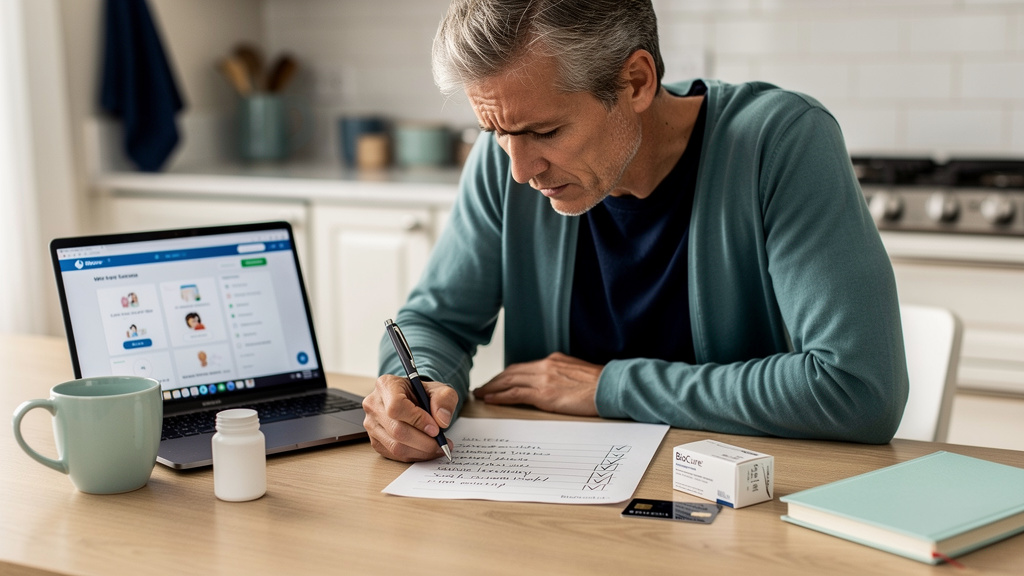
Is this online weight loss clinic legit? 10 checks before you pay
A telehealth weight loss program is legitimate when, before you pay, you can verify who prescribes, exactly which drug you get, which licensed pharmacy makes it, what it costs in total, and how you reach a clinician about side effects. Real programs name a prescriber licensed in your state, require a medical history and labs, and put price and cancellation terms in writing. If a site calls a compounded drug "the same as" or "generic" Wegovy or Zepbound, walk away: that is the exact claim the FDA has warned telehealth companies about.
The FDA warned 30 telehealth companies against illegal marketing of compounded GLP-1s, and its guidance on what telehealth companies should know when promoting compounded drugs reads like a list of what patients should be checking. We turned it into one.
The 10 checks at a glance
| # | Check | Ask before you pay | Red flag |
|---|---|---|---|
| 1 | Named, licensed prescriber | Who prescribes, and are they licensed in my state? | Only "our medical team" |
| 2 | Real evaluation | Will a clinician review my history and labs first? | Instant approval at checkout |
| 3 | Drug named precisely | Brand or compounded? Which pharmacy? | "Our GLP-1" with no details |
| 4 | Honest claims | Do you call compounded drugs generic or identical? | "Generic Zepbound" |
| 5 | Licensed pharmacy | State licensed? FDA registered if 503B? | Pharmacy withheld or overseas |
| 6 | Total price | Full monthly cost at every dose? | Intro price only |
| 7 | Renewal and cancellation | How does billing renew, and how do I cancel? | Prepaid months, no refund policy |
| 8 | Side effect contact path | Who answers, and how fast? | Chat bot only |
| 9 | Privacy | Is the platform HIPAA compliant? | Data shared with advertisers |
| 10 | Dosing clarity | Is my dose in milligrams, with the right syringe? | Dose in "units" only |
Checks 1 and 2: a real prescriber and a real evaluation
1. A named prescriber, licensed in your state
The clinician who prescribes must be licensed in the state where you are located during the visit. Get their full name before you pay and look it up on your state medical board's license search or the Federation of State Medical Boards' DocInfo tool. You want an active license and a clean disciplinary record. A program that hides behind "our provider network" is asking for trust it has not earned.
2. A real evaluation, not a checkout form
GLP-1 drugs have real contraindications. The FDA prescribing information for semaglutide and tirzepatide carries a boxed warning about thyroid C-cell tumors, and these drugs are not for people with a personal or family history of medullary thyroid carcinoma or multiple endocrine neoplasia type 2. Pregnancy plans, past pancreatitis, gallbladder disease, kidney problems and other diabetes medications also change the plan. A proper evaluation covers your history, current medications and baseline labs such as a metabolic panel, A1c, lipids and thyroid markers. If you are approved minutes after entering your card number, nobody evaluated you.
Checks 3 to 5: the drug, the claims and the pharmacy
3. The drug is named precisely
There are two legitimate categories. Brand products, Wegovy (semaglutide) and Zepbound (tirzepatide), are FDA approved for chronic weight management. Compounded versions are made by a pharmacy for an individual prescription and are not FDA approved, which means the FDA has not reviewed them for safety, effectiveness or quality. Compounding has a real role, but you should be told the active ingredient, strength, any added ingredients and the pharmacy's name. Our primer on compound vs traditional pharmacies explains the difference.
One current detail matters: the FDA has declared the national shortages of semaglutide and tirzepatide resolved, which narrows when pharmacies may compound these drugs. Ask the program how its product fits current FDA rules. A specific answer is a good sign; a vague one is not.
4. No "same as" or "generic" claims
This is the clearest theme in the FDA letters. The agency has warned telehealth companies against marketing that suggests a compounded product is FDA approved, is a generic, or is equivalent to an approved drug. There is no FDA approved generic Wegovy or Zepbound in the US. Watch for phrases like "generic Zepbound" and "same as Wegovy," and for brand trial results presented as if they belong to the compounded product.
5. A licensed pharmacy, FDA registered if 503B
A 503A compounding pharmacy fills individual prescriptions and is licensed by state boards of pharmacy. A 503B outsourcing facility registers with the FDA and must meet federal current good manufacturing practice standards. Ask which type supplies you, confirm the license with the state board of pharmacy, and for a 503B, check the FDA's list of registered outsourcing facilities. The pharmacy must also be licensed to ship to your state.
Checks 6 and 7: total price, renewals and cancellation
6. A clear total price
Get the full monthly cost in writing: consult fee, labs, medication, membership, shipping, and whether the price rises as your dose increases. Pricing usually follows one of these models.
| How pricing works | Usually included | Confirm before paying |
|---|---|---|
| Membership plus medication | Clinician access and follow-up | Medication cost at each dose step |
| All-in monthly bundle | Visit, medication and shipping | Whether labs are included; whether the fee rises with dose |
| A la carte | Each visit, lab and refill billed separately | Your realistic monthly total at maintenance |
| Insurance or manufacturer self-pay (brand drugs) | Brand drug through your pharmacy benefit, or direct programs such as LillyDirect and NovoCare | Prior authorization, copay, or the current self-pay price on the manufacturer's site |
On insurance: many telehealth weight programs are cash pay. Coverage of brand GLP-1s for weight loss varies by plan and often requires prior authorization, and compounded drugs are generally not covered. HSA or FSA funds can often be used, so ask for itemized invoices.
7. Renewal terms and cancellation in writing
Before you enter your card, know how often you are billed, whether medication ships automatically, how much notice cancelling takes, and what happens to prepaid medication if a clinician pauses your treatment. A program confident in its care makes leaving easy.
Checks 8 to 10: follow-up, privacy and dosing
8. A real path to a clinician
Nausea, constipation and reflux are common as doses rise. Severe abdominal pain, persistent vomiting or signs of dehydration need a clinician promptly, so confirm before you start who answers, how fast, and whether they can adjust or pause your dose. Scheduled check-ins during dose escalation should be included, not upsold.
9. A HIPAA-compliant platform
Your weight, labs and prescriptions are protected health information. Ask whether the platform is HIPAA compliant, and read the privacy policy for any sharing with advertisers.
10. Dosing written so you cannot get it wrong
The FDA has alerted patients and clinicians to dosing errors with compounded GLP-1s. Compounded products often come in multi-dose vials, and some patients drew up 5 to 20 times the intended dose, partly because instructions mixed units, milliliters and milligrams. Some needed hospital care. A safe program writes your dose in milligrams and as an exact syringe marking, sends the correct syringe, and walks you through your first injection.
Red flags that end the conversation
- No labs, ever, before or during treatment.
- Doses given only in "units" with no syringe or volume guidance.
- Medication shipped from outside the US, or a pharmacy the program will not name.
- Products labeled "for research use only" or "not for human consumption."
- A guaranteed number of pounds by a date.
- Pressure to prepay months before anyone reviews your history.
How enrollment works when it is done right
Legitimate enrollment follows a predictable sequence: intake, a consultation with a licensed clinician, labs, a written protocol naming the drug, dose schedule, pharmacy and total cost, then shipping with scheduled follow-up. Use it as the template for judging any program.
BioCure Health's medical weight loss program follows that sequence. You complete an online intake of about five minutes, then a video consultation with a physician for $199, which can be credited back with a membership. Semaglutide and tirzepatide require that consultation plus a blood panel, done with an at-home kit and in-home phlebotomist or at a lab, with results in 7 to 14 days. A physician reviews your results and protocol with you one on one. Medications ship to your door, typically 5 to 10 business days after consultation and testing, and regular check-ins and maintenance support after you reach your goal are included.
BioCure is physician-led, licensed to treat patients in 47 states (your state is confirmed at intake), and has a clinic in the Fort Lauderdale area if you would rather be seen in person. Our physicians, including co-founders Dr. Joaquin Rosado and Dr. Vaneza Chaple, are named on our team page, so you can run check 1 on us and look them up yourself. You can also ask us which licensed compounding pharmacy partner fills your prescription, and you can reach the team at 754-206-0838 or info@getbiocure.com with any question before you pay.
Where BioCure may not fit: we do not bill health insurance. If your plan covers brand Wegovy or Zepbound, an insurance-billing program or your own doctor may cost you less. Many BioCure patients pay with HSA or FSA funds, and we provide invoices for reimbursement.
Frequently asked questions
How do I know if an online weight loss clinic is legit?
Check that a named prescriber licensed in your state will evaluate you, that labs are required, and that the drug and pharmacy are disclosed. Get the total price and cancellation terms in writing. Any claim that a compounded drug is generic or the same as Wegovy or Zepbound is a reason to leave.
Is compounded semaglutide the same as Wegovy?
No. Wegovy is FDA approved, while compounded semaglutide is made by a pharmacy for an individual prescription and has not been reviewed by the FDA for safety, effectiveness or quality. The FDA has warned telehealth companies against marketing compounded GLP-1s as the same as, or generic versions of, approved drugs.
Do telehealth weight loss programs take insurance?
Some bill insurance, but many are cash pay. Brand GLP-1 coverage for weight loss depends on your plan and often requires prior authorization, while compounded drugs are generally not covered. BioCure does not bill insurance; many patients use HSA or FSA funds with documentation we provide.
Do I need blood work to get a GLP-1 prescription online?
A responsible program will want baseline labs before prescribing, because results can change whether or how a GLP-1 is used. At BioCure, semaglutide and tirzepatide require a consultation and a blood panel. A program that never orders labs is a red flag.
How do I check if an online doctor is licensed in my state?
Ask for the prescriber's full name, then search your state medical board's license lookup or the Federation of State Medical Boards' DocInfo site. Confirm the license is active in the state where you will be during visits, and review any disciplinary actions.
Longevity is not accidental, it is intentional, and so is choosing who treats you. Ten minutes with this checklist protects your health and your money before you commit to months of treatment.
Let BioCure Health lead you in the right direction. Call or text us to schedule an introductory call at 754-206-0838. Your future self will thank you.