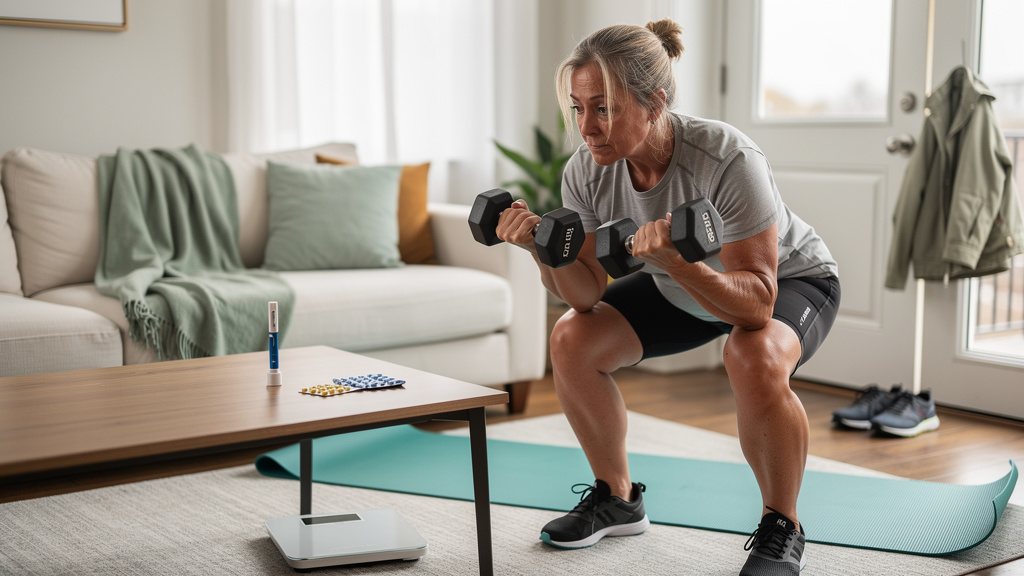
Do you need to exercise on a GLP-1? Strength training to keep muscle
You do not have to work out for a GLP-1 medication to lower the number on the scale. Semaglutide and tirzepatide work mainly by reducing appetite, so most people eat less without extreme dieting. But both are FDA approved for weight management in combination with a reduced-calorie diet and increased physical activity, and without strength training a meaningful share of the weight you lose can come from muscle. Two to three strength sessions a week, plus regular walking, is the practical minimum for keeping muscle, protecting bone and holding on to your results.
That is the short answer. The rest of this guide covers why muscle matters on a GLP-1, the least amount of training that does the job, who needs to be more careful, and how to tell whether your plan is working.
What GLP-1 medications do, and what they do not do
Semaglutide (sold for weight management as Wegovy) is a GLP-1 receptor agonist. Tirzepatide (Zepbound) acts on both GIP and GLP-1 receptors. Both slow stomach emptying and turn down hunger signals, which is why so many patients describe the first few weeks as "the food noise went quiet." That appetite effect is real, and it is the reason these drugs can produce weight loss without the white-knuckle dieting most people have tried before.
What the medication does not do is decide what that weight loss is made of. The FDA prescribing information for both drugs describes them as treatment in combination with a reduced-calorie diet and increased physical activity. That wording is not a formality. It reflects how the medications were studied and how they are meant to be used.
Two other points from official sources are worth knowing before you start:
- Weight tends to come back if you stop. The NIDDK guidance on prescription medications to treat overweight and obesity notes that people often regain weight after stopping these drugs, which is why habits you build now matter later.
- Side effects are mostly digestive. Nausea, diarrhea, vomiting and constipation are the most common. The labels also say these drugs should not be used by people with a personal or family history of medullary thyroid carcinoma or multiple endocrine neoplasia syndrome type 2, which is one reason a physician screens you first.
There is also a quieter problem. When your appetite drops, protein intake often drops with it. Less protein plus no training is the combination most likely to cost you muscle.
How much of the weight you lose can be lean mass
When you lose weight by any method, you lose some lean mass along with fat. On GLP-1 therapy, the losses can be large because total weight loss is large. A review of the body composition data on GLP-1 medications reports that lean mass can account for a substantial share of total weight lost, with wide variation between trials, measurement methods and individual patients.
Two honest caveats belong here. First, "lean mass" on a scan includes water, organs and connective tissue, not only skeletal muscle, so lean mass loss is not identical to muscle loss. Second, researchers are still working out how much this affects strength and function over the long term. The evidence does not say GLP-1s are dangerous for muscle. It says muscle is not protected by default.
Why you should care:
- Muscle is the main tissue that clears glucose from your blood after meals.
- Strength and power predict how well you move, climb stairs and recover from illness as you age.
- Muscle supports balance, which lowers fall risk.
- More muscle helps you keep your results once the dose is lowered or stopped.
We go deeper on the metabolic side in why GLP-1s without muscle support might be sabotaging your metabolism. The goal is not just a smaller body. It is a stronger one.
Minimum effective strength training: 2 to 3 sessions a week
The HHS Physical Activity Guidelines for Americans, 2nd edition, recommend muscle-strengthening activities of moderate or greater intensity that work all major muscle groups on 2 or more days a week. On a GLP-1, treat that as your floor, not your ceiling. Two full-body sessions is the minimum; three gives you more room to progress.
You do not need a complicated program. You need a few compound movements, done with real effort, getting slightly harder over time.
| Session | Lower body | Upper body push | Upper body pull | Core or carry |
|---|---|---|---|---|
| A | Goblet squat or leg press | Push-up or dumbbell bench press | Seated cable row | Plank |
| B | Romanian deadlift or hip hinge | Overhead dumbbell press | Lat pulldown or assisted pull-up | Farmer's carry |
| C (optional) | Step-ups or split squats | Incline press | One-arm dumbbell row | Dead bug |
A few rules that make this work:
- Effort matters more than variety. Finish each set feeling you could do only a couple more reps with good form.
- Progress slowly. Add a rep or a little weight when the last session felt manageable.
- Keep sessions short. Forty to forty-five minutes is plenty. Consistency over months beats intensity for a week.
- Plan around nausea. Many patients feel best training a few days after their weekly injection. On a rough day, do a lighter session instead of skipping the week.
- Prioritize protein. Eat the protein on your plate first when your appetite is small. Your clinician can set a daily target based on your weight, kidney function and goals.
If you are new to lifting, a few sessions with a qualified trainer to learn form is money well spent.
Walking and daily steps vs intense cardio
The same HHS guidelines recommend 150 to 300 minutes a week of moderate aerobic activity, or 75 to 150 minutes of vigorous activity, or an equivalent mix. Brisk walking counts as moderate activity. For most people on a GLP-1, walking is the best way to get there.
The reason is simple. You are eating less than you used to. Long, punishing cardio sessions on a reduced intake can leave you drained, hungry for the wrong foods and too tired to lift. Walking adds movement without eating into your recovery.
| Activity | What it does well | Watch out for | Where it fits on a GLP-1 |
|---|---|---|---|
| Daily walking | Easy to recover from, builds activity minutes, helps after meals | Easy to underestimate how little you move on desk days | Your daily baseline |
| Moderate cardio (cycling, swimming, incline walking) | Heart and lung fitness | Can crowd out strength work if overdone | 2 to 3 sessions a week if you enjoy it |
| High intensity intervals | Time efficient fitness gains | Harder to tolerate with nausea or low intake | Optional, short, once you feel steady |
| Long endurance sessions | Endurance training | Fatigue and under-eating | Only with a clear goal and enough fuel |
A useful habit: a short walk after your largest meal. It is easy to repeat, it adds up across the week, and it does not compete with your strength days. For more ideas, see move more, weigh less: the best exercises for weight loss protocols.
Older adults and women after menopause: bone and muscle risk
If you are over 60, or a woman after menopause, strength training on a GLP-1 moves from recommended to essential.
Muscle mass and strength decline with age even without weight loss. After menopause, falling estrogen speeds up bone loss. Weight loss itself can lower bone density, because a lighter body puts less load on the skeleton. Put those together and rapid weight loss without training can leave you lighter but more fragile.
The HHS guidelines recommend that older adults do multicomponent physical activity, meaning aerobic work, muscle strengthening and balance training together. In practice:
- Keep your 2 to 3 strength sessions, with extra attention to legs and hips.
- Add balance work such as single-leg stands, heel-to-toe walking or tai chi.
- Include weight-bearing activity you can tolerate, like brisk walking or stair climbing.
- Ask your clinician whether a bone density scan makes sense before or during treatment.
Hormones are part of this picture too. For men, BioCure's testosterone therapy program notes that treating confirmed low testosterone can help preserve muscle mass during weight loss. Eligibility depends on your labs and a physician's review, and it is not a substitute for training. For women, BioCure's hormone optimization includes progesterone cream and estradiol patches when they are clinically appropriate.
You may also see peptides marketed for muscle. BioCure's peptide menu includes MOTS-c, which is listed for muscle tone, but the human evidence for it is early and limited. Think of it as a possible add-on to discuss with your clinician, not a replacement for lifting and protein.
Track body composition, not only the scale
The scale tells you that you lost weight. It does not tell you what you lost. If you want to know whether your training is protecting muscle, track a few signals together.
| Measure | What it tells you | How often | Limits |
|---|---|---|---|
| Scale weight | Overall trend | Weekly average | Says nothing about fat vs muscle |
| Waist circumference | Change in abdominal fat | Every 2 to 4 weeks | Measurement technique varies |
| Strength log | Whether muscle function is holding | Every session | Affected by sleep and nausea |
| DEXA scan | Fat, lean mass and bone density | Every few months | Cost and access |
| Bioimpedance scale or device | Rough body composition trend | Monthly, same conditions | Swings with hydration |
| Blood work | Hormones, thyroid, metabolic and organ markers | At baseline and follow-up | Does not measure muscle directly |
The single most practical check is your strength log. If your lifts are holding steady or rising while your weight falls, you are very likely keeping muscle. If your lifts drop sharply, tell your clinician; dose pace, protein or recovery may need adjusting.
How BioCure supports muscle on a GLP-1 protocol
BioCure Health is a physician-led telehealth longevity clinic based in the Fort Lauderdale area and licensed to treat patients in 47 states, with availability in your state confirmed at intake. Our medical weight loss program uses semaglutide or tirzepatide as weekly injections with escalating doses, then maintenance, with physician supervision and regular check-ins.
The process starts with a short online intake and a $199 video consultation with a physician, which can be credited back with a membership. Before medication, you complete lab work through an in-home phlebotomist visit or in-lab testing, including a comprehensive panel of 90+ biomarkers covering hormones, thyroid, lipids, metabolic and organ markers. Results take 7 to 14 days, and a specialist walks you through them. Membership pricing depends on your protocol and is set at your consultation. BioCure does not bill insurance directly, but many patients use HSA or FSA funds with the documentation we provide.
That baseline matters for muscle. It is how we spot low testosterone, thyroid issues or other factors that make holding muscle harder, so your protocol supports the whole body and not only the scale.
Frequently asked questions
Can I lose weight on Ozempic or Wegovy without exercising?
Yes, semaglutide lowers appetite enough that most people lose weight without a formal exercise routine. However, the FDA approved it for weight management in combination with diet and increased physical activity. Without strength training, more of the weight you lose may come from lean mass.
How many days a week should I lift weights on a GLP-1?
Aim for at least 2 full-body strength sessions a week, which matches the HHS Physical Activity Guidelines minimum, and 3 if you can recover well. Focus on squats, hinges, presses and rows, and add weight or reps gradually.
Is walking enough exercise while taking tirzepatide?
Walking is excellent for activity minutes and is easy to recover from, but it does not provide enough challenge to protect muscle on its own. Pair daily walking with 2 to 3 strength sessions a week for the best chance of keeping lean mass.
Do GLP-1 drugs cause muscle loss?
Any significant weight loss includes some lean mass loss, and GLP-1 medications produce large weight loss. Reviews of the trial data show lean mass can be a substantial share of the total, though it varies widely. Strength training and adequate protein are the main tools to reduce it.
Will I gain the weight back if I stop my GLP-1?
NIDDK notes that weight is often regained after these medications are stopped. Building strength, walking and eating habits while you are on the medication gives you a better foundation if your dose is lowered or stopped later.
Should women over 50 do anything different on a GLP-1?
Women after menopause face faster bone loss, so strength training, balance work and weight-bearing activity are especially important. Ask your clinician whether a bone density scan or hormone evaluation makes sense before or during treatment.
A GLP-1 can make eating less feel easy. What you do with that window decides whether you come out lighter or genuinely healthier: lift a few times a week, walk every day, eat your protein and measure what matters. Longevity is not accidental, it is intentional.
Let BioCure Health lead you in the right direction. Call or text us to schedule an introductory call at 754-206-0838. Your future self will thank you.